How to protect the connections that keep your systems, data, and teams
Secure integrations help organizations move fast without sacrificing control.
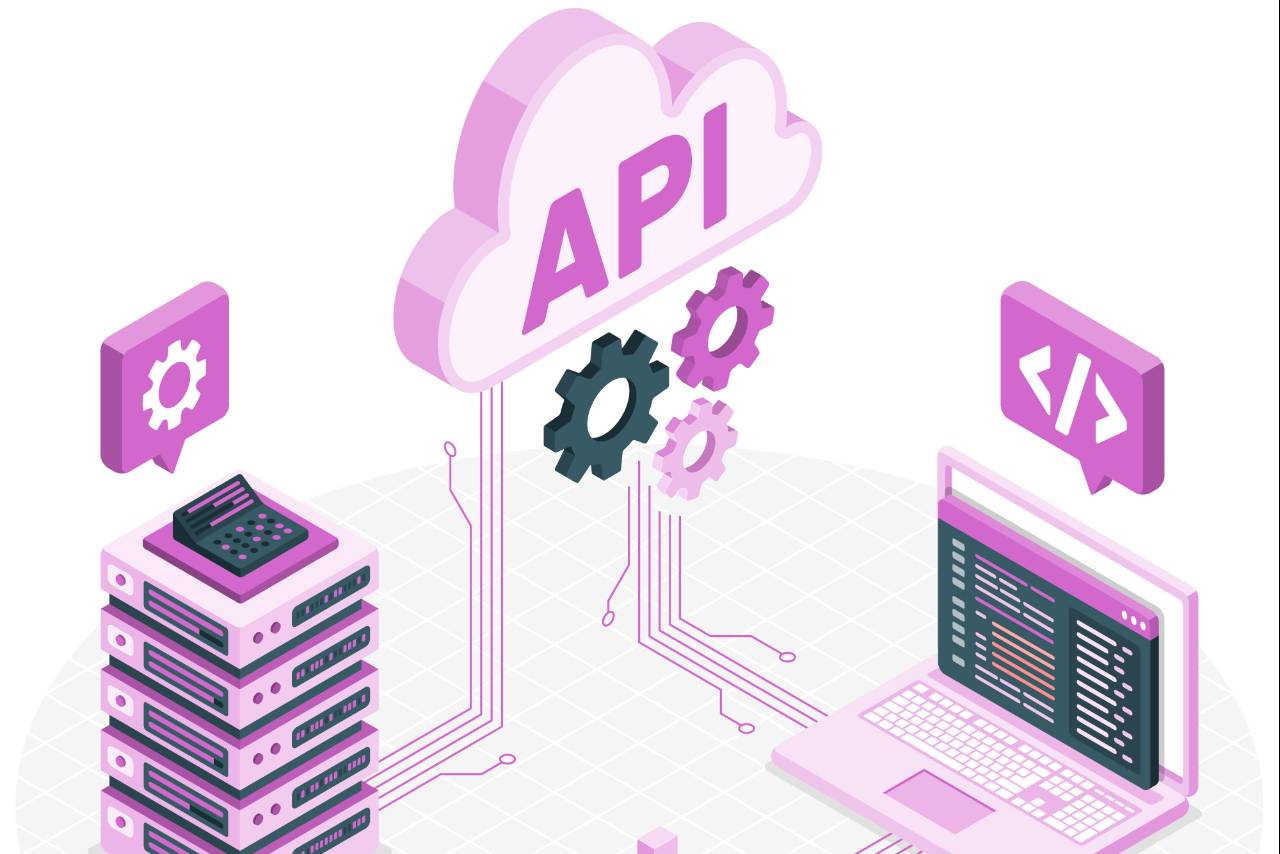
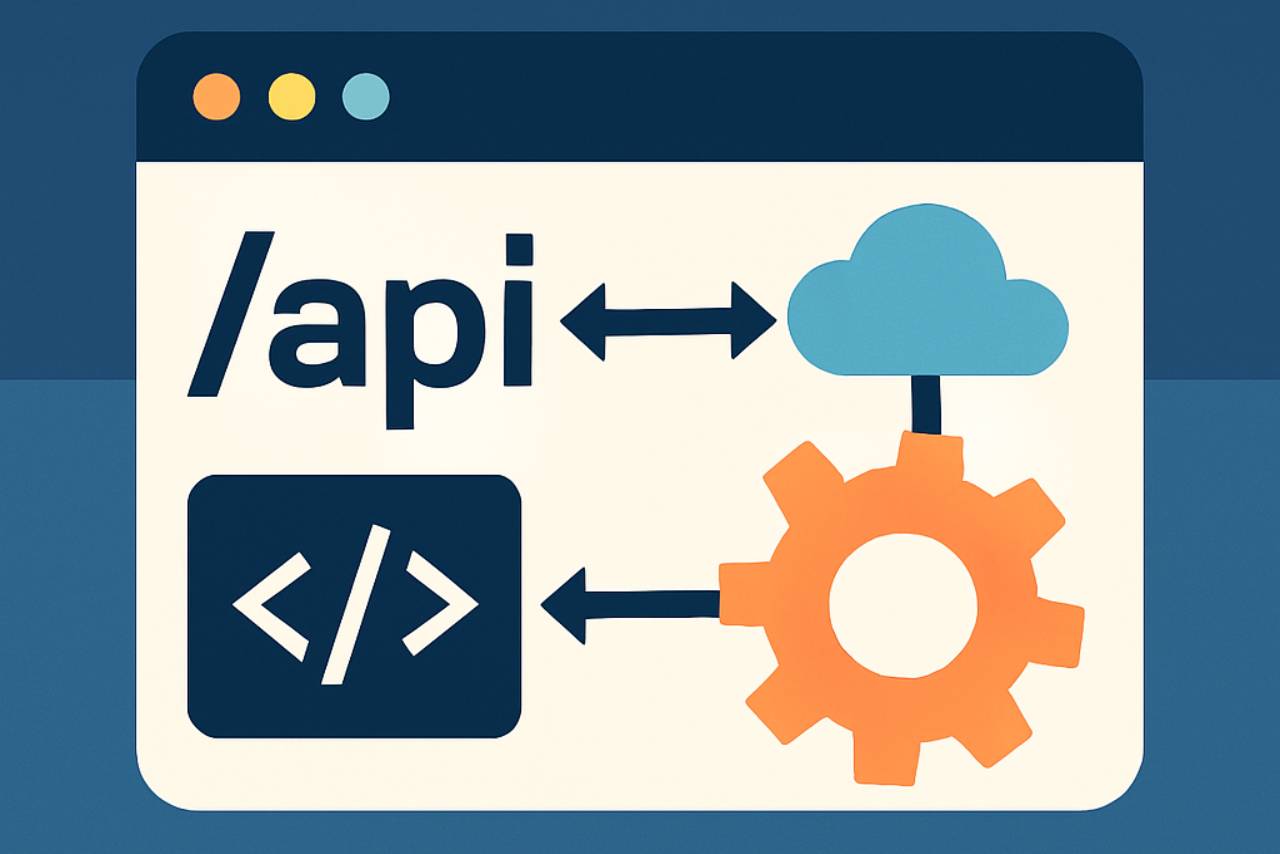
APIs are the quiet infrastructure behind modern business. They move employee data from HR to payroll, push sales into analytics, sync inventory across channels, and trigger workflows that teams rely on every day. When those connections are secure, the business runs with confidence. When they are not, a single weak endpoint can expose sensitive data, disrupt operations, or create compliance risk often before anyone realizes something is wrong.
In this post, we'll look at why API security becomes harder as organizations scale, what 'secure by design' really means in an integration-heavy environment, and how a centralized integration layer can make security repeatable instead of reactive.
APIs are the quiet infrastructure behind modern business. They move employee data from HR to payroll, push sales into analytics, sync inventory across channels, and trigger workflows that teams rely on every day. When those connections are secure, the business runs with confidence. When they are not, a single weak endpoint can expose sensitive data, disrupt operations, or create compliance risk often before anyone realizes something is wrong.
In this post, we'll look at why API security becomes harder as organizations scale, what 'secure by design' really means in an integration-heavy environment, and how a centralized integration layer can make security repeatable instead of reactive.
APIs don't just connect tools - they connect outcomes
It's easy to think of APIs as plumbing- necessary, but not strategic. In reality, APIs are how modern enterprises turn software into an operating model. They enable automation, reduce handoffs, and create the real-time visibility leaders need to make decisions. The catch is that every new integration increases both capability and exposure.
Why security gets harder as integration complexity grows
Most enterprises don't run one platform; they run an ecosystem. ERP, HR, finance, analytics, and customer-facing apps are constantly exchanging information through APIs. Over time, teams accumulate credentials, mappings, schedules, and exceptions. Risk grows quietly- a misconfigured endpoint here, an outdated token there, a deprecated integration no one is monitoring.
This is where API security stops being a one-time implementation and becomes a lifecycle responsibility- discovery, access control, encryption, monitoring, and governance - all maintained as the stack evolves.
For a deeper look at common API threats and best practices, see API Security- Protecting Your Data in a Connected World.
This is where API security stops being a one-time implementation and becomes a lifecycle responsibility- discovery, access control, encryption, monitoring, and governance - all maintained as the stack evolves.
For a deeper look at common API threats and best practices, see API Security- Protecting Your Data in a Connected World.
The biggest risk is "invisible drift"
Many breaches don't come from a dramatic exploit; they come from drift. Settings change. Vendors update. Teams rotate. An integration that was secure last quarter becomes fragile this quarter because a logging rule was disabled, a certificate expired, or a new workflow bypassed review.
| Watch for these drift signals- If teams rely on spreadsheets to validate reports, if exceptions are 'normal,' or if no one can answer 'Which systems can call this API?', security and reliability are already slipping. |
What secure-by-design looks like for integrations
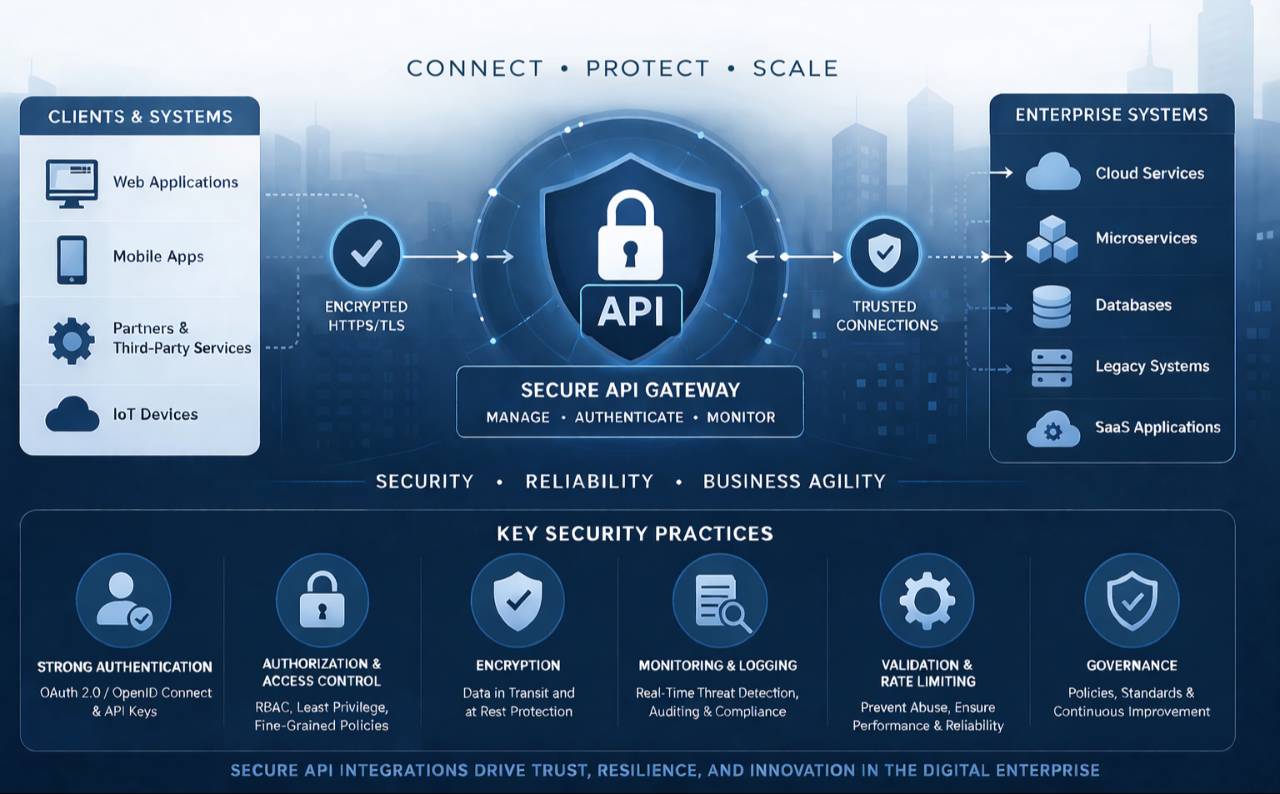
Secure API integrations aren't about locking everything down, they're about making access intentional, data protected, and behavior visible.
At a practical level, four pillars matter most-
At a practical level, four pillars matter most-
- Identity & access- strong authentication, least-privilege authorization, and controlled credential rotation.
- Encryption in transit- TLS everywhere to reduce interception risk and meet compliance expectations.
- Observability- centralized logging, alerting, and anomaly detection so unusual behavior is surfaced quickly.
- Governance- consistent standards for how integrations are created, approved, versioned, and retired.
Streamline Your Inventory. Order Smartly.
Start Simplifying Your Orders with Any Connector
Platform-led integration makes security repeatable
Point-to-point connections can feel fast until the third system is added and every change becomes a chain reaction. A platform-led approach replaces a web of one-off connections with a controlled integration layer where policies, monitoring, and standards are applied consistently.
Any Connector explains this shift well in From Point-to-Point to Platform-Led Integrations, especially how centralized control reduces fragility as stacks grow.
Any Connector explains this shift well in From Point-to-Point to Platform-Led Integrations, especially how centralized control reduces fragility as stacks grow.
Where Any Connector fits
Any Connector supports secure integrations by centralizing how APIs are managed and monitored. Instead of rebuilding security expectations for every new connection, teams can standardize governance, improve visibility, and reduce operational risk through one integration layer.
That centralization matters because it scales with the business. As new systems come online, the goal isn't simply to connect them, it's to connect them in a way that keeps data trustworthy and operations stable.
Zooming out, integration strategy is increasingly a competitive decision not just an IT task. If you want the forward-looking view, read The Future of Enterprise Integrations 2026 and Beyond.
That centralization matters because it scales with the business. As new systems come online, the goal isn't simply to connect them, it's to connect them in a way that keeps data trustworthy and operations stable.
Zooming out, integration strategy is increasingly a competitive decision not just an IT task. If you want the forward-looking view, read The Future of Enterprise Integrations 2026 and Beyond.
The takeaway
Secure API integrations protect more than systems, they protect trust. When payroll runs cleanly, reports agree, and customer data stays safe, teams can move faster because they aren't spending time validating, reconciling, or recovering.
If your organization is adding tools, expanding locations, or modernizing workflows, treat API security as part of your integration foundation. The best time to design for governance and monitoring is before complexity makes it urgent.
If your organization is adding tools, expanding locations, or modernizing workflows, treat API security as part of your integration foundation. The best time to design for governance and monitoring is before complexity makes it urgent.
| Ready to reduce integration risk? A centralized integration layer helps you apply consistent security, monitoring, and governance across every connection without slowing down innovation. |
Recommended
integrated-platforms

integrated-platforms
Automation in Hospitality- Transforming Guest Experiences and

integrated-platforms

integrated-platforms

integrated-platforms

integrated-platforms

integrated-platforms

integrated-platforms

integrated-platforms
integrated-platforms
integrated-platforms

integrated-platforms

integrated-platforms
integrated-platforms

integrated-platforms
integrated-platforms
integrated-platforms
integrated-platforms
integrated-platforms
integrated-platforms
integrated-platforms
integrated-platforms

integrated-platforms
How Integration Platforms Are Revolutionizing Business Technology
integrated-platforms
integrated-platforms
integrated-platforms
integrated-platforms
integrated-platforms
Overcoming API Documentation Challenges- How Middleware Bridges
integrated-platforms
integrated-platforms
integrated-platforms
Composable Architecture- Building Modular Restaurant Tech Stacks
integrated-platforms
integrated-platforms
Low-Code/No-Code API Integration for Non-Tech Restaurant Teams

integrated-platforms
integrated-platforms
integrated-platforms
integrated-platforms
integrated-platforms
integrated-platforms
integrated-platforms
integrated-platforms
integrated-platforms
integrated-platforms
integrated-platforms

integrated-platforms

integrated-platforms

integrated-platforms
integrated-platforms
integrated-platforms
integrated-platforms
integrated-platforms

integrated-platforms
integrated-platforms

integrated-platforms

integrated-platforms
integrated-platforms
integrated-platforms
integrated-platforms
integrated-platforms
integrated-platforms
integrated-platforms

integrated-platforms
integrated-platforms
integrated-platforms
integrated-platforms
integrated-platforms
integrated-platforms
From Point-to-Point to Platform-Led Integrations- Why Growing
integrated-platforms
integrated-platforms