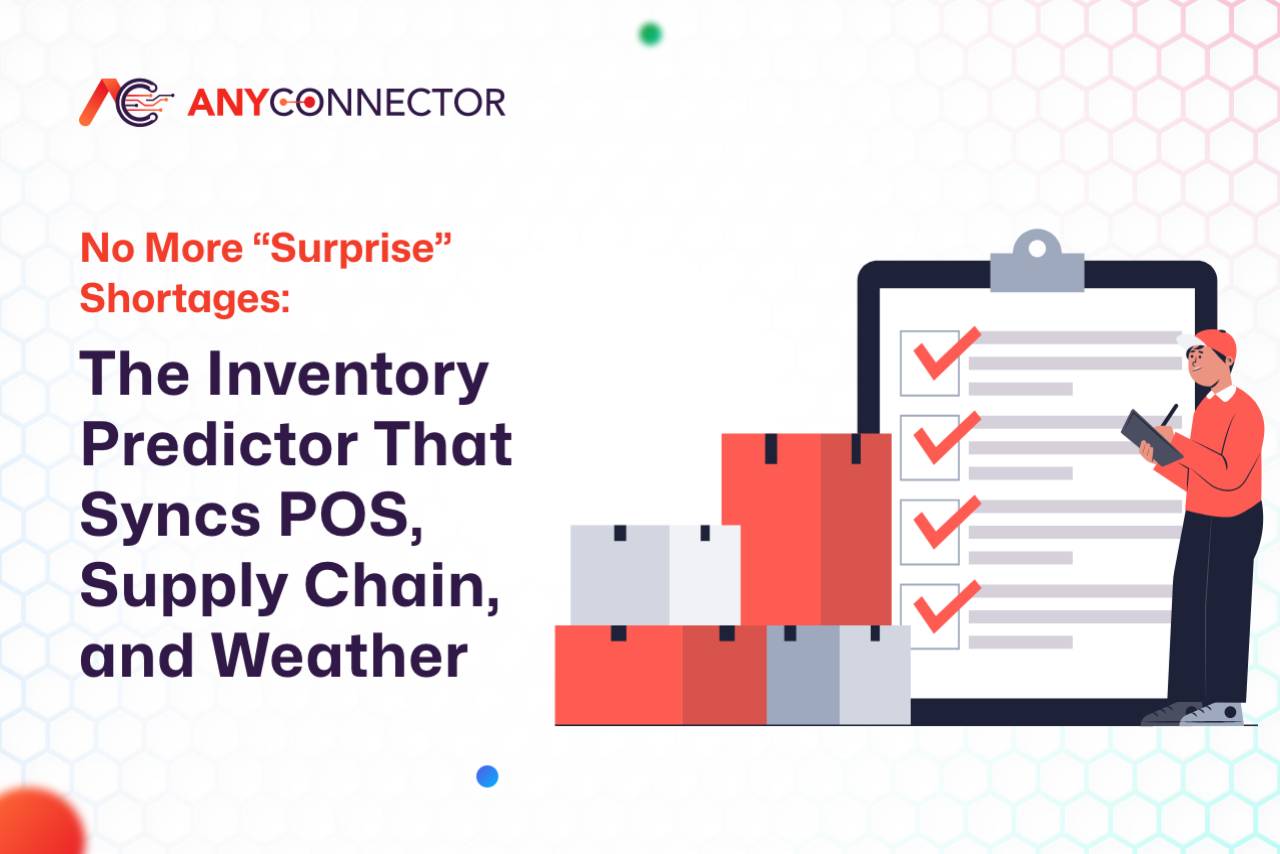
Ever had that moment when your store's shelves are empty of a hot item, or you're staring at weeks of overstock on last season's slow mover? These surprise shortages and excesses don't happen by accident they happen when your sales system, supply-chain data, and external signals don't talk to each other.
In this blog, we'll show how combining POS transaction data, supplier lead times, and even weather or local events via a robust integration platform lets you move from reacting to predicting. With predictive inventory management, you can proactively suggest purchase orders before the shortage even happens.
In this blog, we'll show how combining POS transaction data, supplier lead times, and even weather or local events via a robust integration platform lets you move from reacting to predicting. With predictive inventory management, you can proactively suggest purchase orders before the shortage even happens.
1. Why Basic Inventory Tracking Isn't Enough?
Traditional inventory tracking only tells you what happened not what's about to happen. You get alerts when stock hits zero or when you've overstocked, but by then it's too late. Today's dynamic retail and restaurant environments demand more foresight.
When your POS, supply chain, and external data sources aren't connected, you face challenges like-
When your POS, supply chain, and external data sources aren't connected, you face challenges like-
- Sudden sales spikes driven by local events or weather changes.
- Delayed supplier lead times that disrupt restock schedules.
- Channel-specific blind spots where online and in-store demand don't align.
2. The Business Cost of Being Reactive
Being reactive with inventory isn't just inconvenient, it's expensive.
- Lost Sales- Customers leave when shelves are empty.
- Rush Restocks- Emergency orders drive up freight and operational costs.
- Overstock- Cash gets tied up in unsold products.
- Supply Chain Inefficiencies- You're constantly fighting delays and errors.
- Damaged Customer Trust- Frequent shortages hurt reliability and satisfaction.
3. The Solution- Predictive Inventory with Real-Time Integration
The answer lies in integration. By connecting POS, supply-chain data, and external sources like weather or local event APIs through an iPaaS such as @Any Connector, you can transform how your business forecasts demand and manage stock.
Here's how it works-
Here's how it works-
- Your POS continuously feeds sales data into a unified dashboard.
- Supplier lead times and delivery schedules are connected in real time.
- Weather forecasts and event calendars provide external demand signals.
- Predictive algorithms identify future demand trends and alert you to reorder before stock runs low.
4. What to Look for in an Inventory Predictor
When evaluating predictive inventory tools or integration platforms, focus on these key capabilities-
- Real-Time POS Integration- Ensure all sales channels feed accurate, live data.
- Supply-Chain Forecasting- Integrate supplier data, lead times, and delivery metrics.
- External Data Connectors- Pull in weather forecasts, event data, or regional trends.
- Unified Dashboard- Get a single view of sales, stock, and predictive analytics.
- Automated Reorder Suggestions- Let the system recommend purchase orders.
- Scalable Integration Platform- A cloud-native system that grows with your operations.
- Predictive Analytics & Alerts- Get proactive notifications on potential shortages.
Streamline Your Inventory. Order Smartly.
Start Simplifying Your Orders with Any Connector
5. Quick Action Checklist
Ready to future-proof your inventory? Here's how to start-
- Audit your current systems POS, supply chain, weather/event integrations.
- Identify where data delays or silos exist.
- Choose an integration platform (like Any Connector) that connects POS, suppliers, and external data.
- Set up real-time syncing and predictive dashboards.
- Run test forecasts and compare them with actual sales trends.
- Use predictive insights to create purchase orders in advance.
- Track performance monthly and refine your thresholds and alert settings.
Conclusion
Inventory surprises whether it's an empty shelf or an overstocked warehouse are a symptom of disconnected systems. When your POS, supply chain, and external data don't sync, you're always one step behind demand.
By integrating all your data sources through Any Connector's iPaaS, you can build a predictive inventory engine that anticipates needs, optimizes purchasing, and prevents loss. This is how smart brands turn data into foresight and foresight into profit.
Ready to eliminate surprise shortages?
Discover how Any Connector's integration platform unifies your POS, supply chain, and external data feeds so you can predict demand, prevent stockouts, and power smarter purchasing.
By integrating all your data sources through Any Connector's iPaaS, you can build a predictive inventory engine that anticipates needs, optimizes purchasing, and prevents loss. This is how smart brands turn data into foresight and foresight into profit.
Ready to eliminate surprise shortages?
Discover how Any Connector's integration platform unifies your POS, supply chain, and external data feeds so you can predict demand, prevent stockouts, and power smarter purchasing.
Recommended
integrated-platforms

integrated-platforms
Automation in Hospitality- Transforming Guest Experiences and

integrated-platforms

integrated-platforms

integrated-platforms

integrated-platforms

integrated-platforms
integrated-platforms

integrated-platforms

integrated-platforms
integrated-platforms

integrated-platforms

integrated-platforms
integrated-platforms

integrated-platforms

integrated-platforms
integrated-platforms
integrated-platforms
integrated-platforms
integrated-platforms
integrated-platforms
integrated-platforms
integrated-platforms
How Integration Platforms Are Revolutionizing Business Technology

integrated-platforms
integrated-platforms
integrated-platforms
integrated-platforms
integrated-platforms
Overcoming API Documentation Challenges- How Middleware Bridges
integrated-platforms
integrated-platforms
integrated-platforms
Composable Architecture- Building Modular Restaurant Tech Stacks
integrated-platforms
integrated-platforms
Low-Code/No-Code API Integration for Non-Tech Restaurant Teams

integrated-platforms
integrated-platforms
integrated-platforms
integrated-platforms
integrated-platforms

integrated-platforms
integrated-platforms
integrated-platforms
integrated-platforms
integrated-platforms
integrated-platforms
integrated-platforms

integrated-platforms
integrated-platforms
integrated-platforms
integrated-platforms
integrated-platforms
integrated-platforms
integrated-platforms
integrated-platforms

integrated-platforms

integrated-platforms
integrated-platforms
integrated-platforms
integrated-platforms
integrated-platforms
integrated-platforms
integrated-platforms
integrated-platforms
integrated-platforms
integrated-platforms
integrated-platforms
integrated-platforms
integrated-platforms
From Point-to-Point to Platform-Led Integrations- Why Growing
integrated-platforms
integrated-platforms