Most restaurant problems don't start in the kitchen.
They start quietly in your data.
Orders look normal. Payroll seems close enough. Inventory mostly matches. Yet margins shrink, guests complain, and managers feel like they're always catching up.
That's usually not a people problem; it's a systems problem.
When POS, payroll, inventory, delivery, loyalty, and accounting tools don't share data cleanly, the business runs on partial truths. The results show up as mystery variance, inconsistent reporting, and operational chaos that's hard to trace back to a single cause.
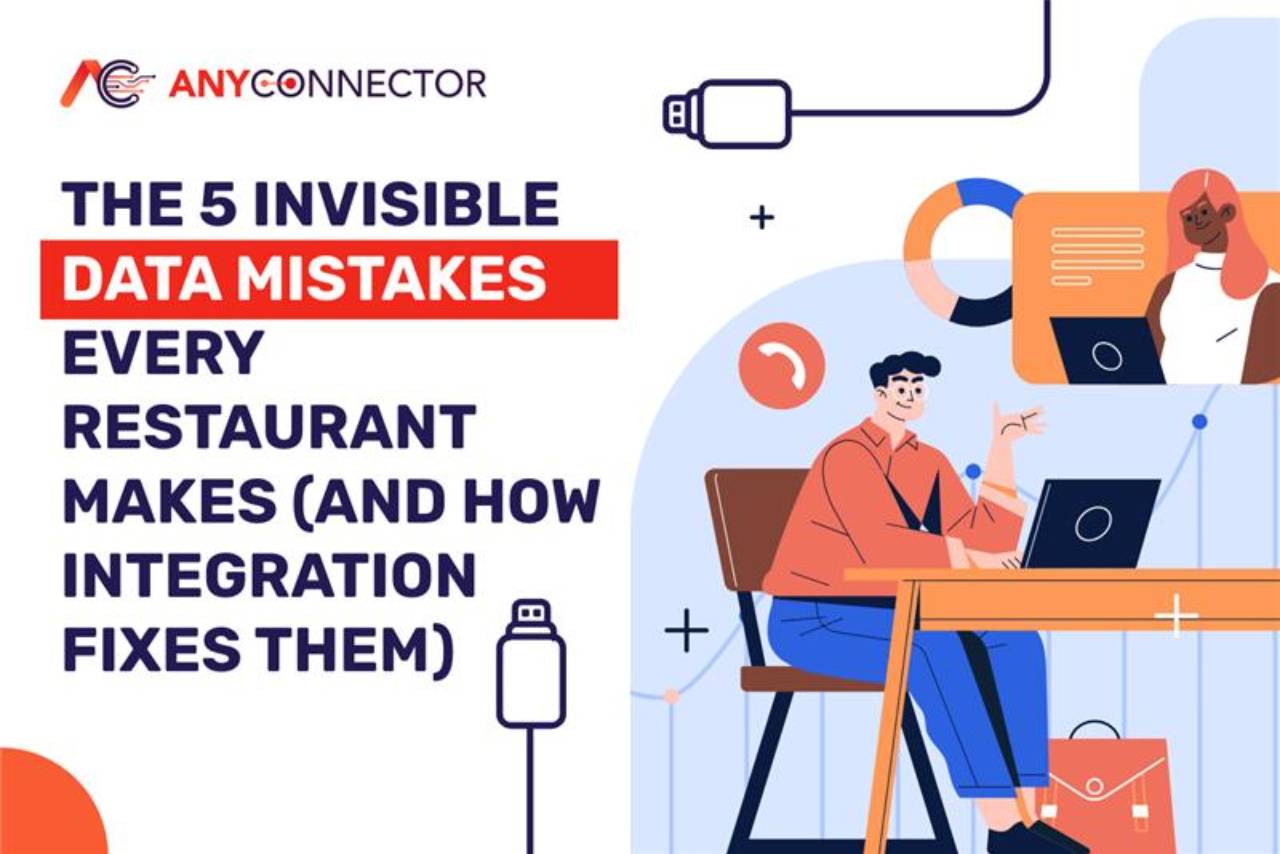
Here are five of the most common invisible data mistakes and how integration eliminates them.
They start quietly in your data.
Orders look normal. Payroll seems close enough. Inventory mostly matches. Yet margins shrink, guests complain, and managers feel like they're always catching up.
That's usually not a people problem; it's a systems problem.
When POS, payroll, inventory, delivery, loyalty, and accounting tools don't share data cleanly, the business runs on partial truths. The results show up as mystery variance, inconsistent reporting, and operational chaos that's hard to trace back to a single cause.
Here are five of the most common invisible data mistakes and how integration eliminates them.
1) Inventory That Lies to You
You sold 40 burgers but your inventory count says you still have patties left.
This happens when sales move instantly, but inventory update slag behind (or rely on manual imports). Without real-time POS-to-inventory sync, you're looking at yesterday's stock picture while today's decisions depend on accuracy.
What it causes-
This happens when sales move instantly, but inventory update slag behind (or rely on manual imports). Without real-time POS-to-inventory sync, you're looking at yesterday's stock picture while today's decisions depend on accuracy.
What it causes-
- Inflated on-hand counts
- Surprise stockouts
- Over-ordering and food waste
- Misleading COGS and margin reporting

Have full control over your software integrations at all times.
Any Connector makes it easy for you to get full control over your software integrations.
2) Ghost Orders That Never Reach the Kitchen
The customer ordered.
The app confirmed it.
But the kitchen never saw it.
When delivery platforms, kiosks, and online ordering tools aren't fully integrated with your POS and KDS, orders can fall into black holes- delays, duplication, partial modifiers, or missing tickets.
What it causes-
The app confirmed it.
But the kitchen never saw it.
When delivery platforms, kiosks, and online ordering tools aren't fully integrated with your POS and KDS, orders can fall into black holes- delays, duplication, partial modifiers, or missing tickets.
What it causes-
- Remakes and refunds
- Long wait times and poor reviews
- Staff frustration (We never got that order.)
- Lost revenue you may never notice
3) Refunds and Adjustments That Don't Reconcile
You processed the refund but accounting, payments, and customer records didn't get the message (at least not right away).
In disconnected environments, refunds can take hoursor longer to appear across financial and customer systems. That delay creates mismatched books,support headaches, and unnecessary guest friction.
What it causes-
In disconnected environments, refunds can take hoursor longer to appear across financial and customer systems. That delay creates mismatched books,support headaches, and unnecessary guest friction.
What it causes-
- Reconciliation gaps
- Disputed transactions and chargebacks
- Customer trust issues (You said it was refunded.)
- Manual work for finance teams
4) Payroll Discrepancies No One Can Explain
Labor costs rise, but sales didn't.
When time clocks, schedules, POS, and payroll live in silos, managers end up doing spreadsheet detective work- comparing hours, roles, job codes, overtime rules, breaks, and wage rates across multiple systems.
What it causes-
When time clocks, schedules, POS, and payroll live in silos, managers end up doing spreadsheet detective work- comparing hours, roles, job codes, overtime rules, breaks, and wage rates across multiple systems.
What it causes-
- Payroll processing delays
- Increased compliance risk
- Misallocated labor by job/department
- Higher hidden admin cost every pay cycle
Your one stop shop for the latest news
Subscribe and stay informed about everything restaurant and food related!
5) Reports That Tell Yesterday's Story
By the time reports arrive, the moment has passed.
Batch exports and delayed sync mean leaders are always reacting, not steering. When reports are built on stale or incomplete feeds, decisions get made lateand often based on the wrong version of the truth.
What it causes-
Batch exports and delayed sync mean leaders are always reacting, not steering. When reports are built on stale or incomplete feeds, decisions get made lateand often based on the wrong version of the truth.
What it causes-
- Slow operational response
- Missed trends and anomalies
- Inconsistent KPIs across departments
- Low confidence in reporting
Why These Problems Keep Happening
Because restaurants keep adding tools but don't connect them.
New channels, new apps, new systems. Each one helps in isolation, but every disconnected platform introduces new failure points- mismatched IDs, partial item mapping, timing delays, duplicate records, and manual patchwork processes.
The answerisn't more software.
It's simplified system integration.
New channels, new apps, new systems. Each one helps in isolation, but every disconnected platform introduces new failure points- mismatched IDs, partial item mapping, timing delays, duplicate records, and manual patchwork processes.
The answerisn't more software.
It's simplified system integration.
How Any Connector Fixes All Five at Once
Any Connector is the integration layer behind modern restaurant operations built to connect the systems you already use and keep data moving reliably between them.
With Any Connector, you can-
With Any Connector, you can-
- Sync POS, inventory, payroll, loyalty, accounting, and delivery data through a unified integration approach
- Support multi-system, multi-location environments (including franchises and enterprise brands)
- Maintain secure, scalable, enterprise-grade connectivity
- Bridge legacy tools and modern platforms without ripping and replacing systems
Final Thought
Restaurants don't struggle because people make mistakes.
They struggle because data does.
Invisible data errors quietly drain margins until the business feels harder than it should. But when systems are connected, operations stabilize, decisions speed up, and guests feel the difference.
Because in today's restaurant environment, clarity isn't optional, it's a competitive advantage.
Want to eliminate data gaps across your restaurant systems?
Explore how Any Connector simplifies restaurant integration and keeps everything in sync.
They struggle because data does.
Invisible data errors quietly drain margins until the business feels harder than it should. But when systems are connected, operations stabilize, decisions speed up, and guests feel the difference.
Because in today's restaurant environment, clarity isn't optional, it's a competitive advantage.
Want to eliminate data gaps across your restaurant systems?
Explore how Any Connector simplifies restaurant integration and keeps everything in sync.
Recommended
integrated-platforms

integrated-platforms
Automation in Hospitality- Transforming Guest Experiences and

integrated-platforms

integrated-platforms

integrated-platforms

integrated-platforms

integrated-platforms
integrated-platforms

integrated-platforms

integrated-platforms
integrated-platforms

integrated-platforms

integrated-platforms
integrated-platforms

integrated-platforms

integrated-platforms
integrated-platforms
integrated-platforms
integrated-platforms
integrated-platforms
integrated-platforms
integrated-platforms
integrated-platforms
How Integration Platforms Are Revolutionizing Business Technology
integrated-platforms
integrated-platforms
integrated-platforms
integrated-platforms
integrated-platforms
Overcoming API Documentation Challenges- How Middleware Bridges
integrated-platforms
integrated-platforms
integrated-platforms
Composable Architecture- Building Modular Restaurant Tech Stacks
integrated-platforms
integrated-platforms
Low-Code/No-Code API Integration for Non-Tech Restaurant Teams

integrated-platforms
integrated-platforms
integrated-platforms
integrated-platforms
integrated-platforms
integrated-platforms
integrated-platforms
integrated-platforms
integrated-platforms
integrated-platforms
integrated-platforms
integrated-platforms

integrated-platforms
integrated-platforms
integrated-platforms
integrated-platforms
integrated-platforms
integrated-platforms
integrated-platforms
integrated-platforms

integrated-platforms

integrated-platforms
integrated-platforms
integrated-platforms
integrated-platforms
integrated-platforms
integrated-platforms
integrated-platforms
integrated-platforms
integrated-platforms
integrated-platforms
integrated-platforms
integrated-platforms
integrated-platforms
From Point-to-Point to Platform-Led Integrations- Why Growing
integrated-platforms
integrated-platforms