Introduction
Integration platforms are becoming the operational command layer for connected businesses.
For years, integration platforms were treated as quiet infrastructure. Their job was simple enough - moving data from one application to another, keeping records aligned, and reducing the manual work that comes with disconnected systems.
That role still matters, but it no longer captures the full value of integration. Today’s businesses run across cloud applications, APIs, enterprise platforms, analytics tools, and third-party services. Every customer interaction, payroll update, inventory change, financial transactions, and operational handoff depend on those systems working together in the right sequence.
The result is a clear shift - integration platforms are becoming the control layer of modern operations. They do not just connect technology. They help coordinate work, monitor performance, enforce consistency, and give teams the visibility they need to run the business with confidence.
For years, integration platforms were treated as quiet infrastructure. Their job was simple enough - moving data from one application to another, keeping records aligned, and reducing the manual work that comes with disconnected systems.
That role still matters, but it no longer captures the full value of integration. Today’s businesses run across cloud applications, APIs, enterprise platforms, analytics tools, and third-party services. Every customer interaction, payroll update, inventory change, financial transactions, and operational handoff depend on those systems working together in the right sequence.
The result is a clear shift - integration platforms are becoming the control layer of modern operations. They do not just connect technology. They help coordinate work, monitor performance, enforce consistency, and give teams the visibility they need to run the business with confidence.
From Connected Systems to Connected Operations
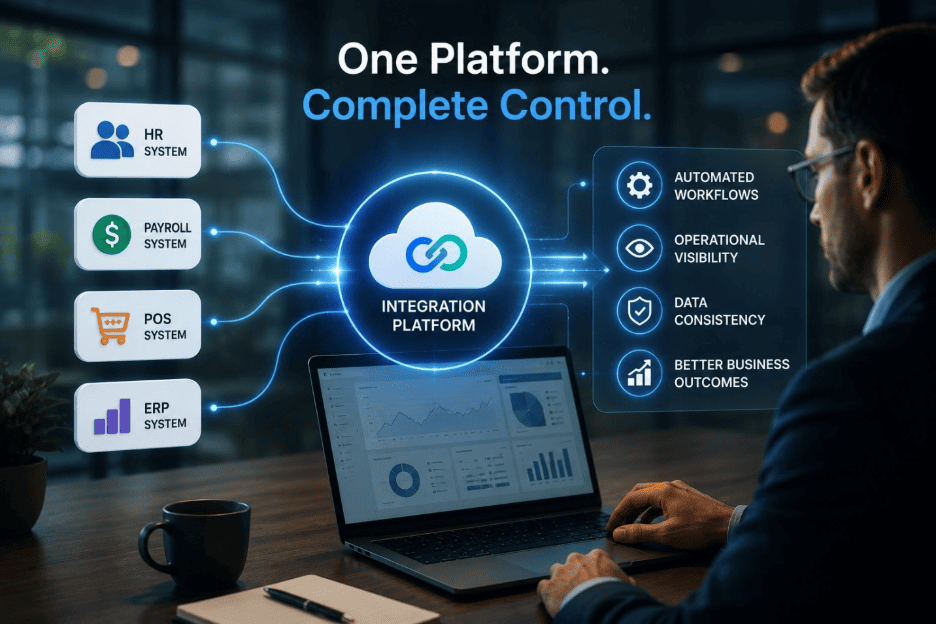
Most organizations already rely on specialized systems for HR, payroll, finance, sales, inventory, scheduling, reporting, and customer engagement. Each application plays a vital role, but the real business value appears when those systems behave as one connected operating model.
A completed sync is useful, but it does not always mean the work is complete. A new employee record may move into payroll, yet onboarding still requires approvals, access setup, manager notifications, training assignments, and reporting updates. This is the difference between moving data and moving the business forward.
AnyConnector explores this same idea in Why Data Synchronization Alone Is No Longer Enough, where the focus moves beyond basic data transfer and toward workflow orchestration. The takeaway is simple - connected data is the foundation, but connected operations are the goal.
A completed sync is useful, but it does not always mean the work is complete. A new employee record may move into payroll, yet onboarding still requires approvals, access setup, manager notifications, training assignments, and reporting updates. This is the difference between moving data and moving the business forward.
AnyConnector explores this same idea in Why Data Synchronization Alone Is No Longer Enough, where the focus moves beyond basic data transfer and toward workflow orchestration. The takeaway is simple - connected data is the foundation, but connected operations are the goal.
Why the Control Layer Matters
As companies add more systems, integration complexity grows quickly. Point-to-point connections may solve immediate problems, but they can also create scattered logic, duplicated rules, and workflows that become difficult to monitor or change. Over time, teams may not know which system owns the truth, where exceptions are managed, or what breaks when one platform changes.
A modern integration platform creates a central place to manage how systems interact. It can define business rules, apply validation logic, transform data, route exceptions, and trigger actions across multiple applications. Instead of every department building its own version of workflow, the organization gains a shared operational framework.
This is where the idea of a control layer becomes powerful. It gives businesses a structured way to manage change without losing consistency. New applications can be added more easily, existing workflows can be adjusted centrally, and operational logic can scale alongside the business.
A modern integration platform creates a central place to manage how systems interact. It can define business rules, apply validation logic, transform data, route exceptions, and trigger actions across multiple applications. Instead of every department building its own version of workflow, the organization gains a shared operational framework.
This is where the idea of a control layer becomes powerful. It gives businesses a structured way to manage change without losing consistency. New applications can be added more easily, existing workflows can be adjusted centrally, and operational logic can scale alongside the business.
Visibility Turns Integration into Operational Confidence
Connectivity alone is not enough if teams cannot see what is happening between systems. A failed API call, delayed employee sync, mapping error, or incomplete transaction can affect payroll, reporting, fulfilment, customer communication, or compliance. The issue is often not failure itself; it is how long it stays hidden.
Modern integration platforms bring monitoring, transaction tracking, error handling, and real-time operational insight into one place. IT teams can diagnose problems faster, business users can trust process status, and leaders can understand how digital operations are performing across the organization.
This is Why Integration Visibility Is Becoming the Backbone of Modern IT Operations is such a relevant companion read. Visibility is no longer a technical nice-to-have. It is becoming a core requirement for reliability, resilience, and smarter operations.
Modern integration platforms bring monitoring, transaction tracking, error handling, and real-time operational insight into one place. IT teams can diagnose problems faster, business users can trust process status, and leaders can understand how digital operations are performing across the organization.
This is Why Integration Visibility Is Becoming the Backbone of Modern IT Operations is such a relevant companion read. Visibility is no longer a technical nice-to-have. It is becoming a core requirement for reliability, resilience, and smarter operations.
Connected Operations Help Businesses Move Faster
Speed has become a strategic advantage, but speed depends on more than adding new tools. Teams need the ability to launch workflows, test ideas, adjust processes, and adopt new applications without rebuilding the technology landscape every time something changes.
A flexible integration platform reduces that friction. When reusable integrations and centralized workflows are already in place, teams can experiment with new customer experiences, reporting models, automation paths, and operational improvements with less risk. Any Connector’s blog How Integration Platforms Help Businesses Experiment Faster expands on this point by showing how connected systems make innovation more practical.
When integration is treated as a platform capability rather than a one-off project, change becomes easier to manage. The business can move faster while still maintaining governance, visibility, and consistency.
A flexible integration platform reduces that friction. When reusable integrations and centralized workflows are already in place, teams can experiment with new customer experiences, reporting models, automation paths, and operational improvements with less risk. Any Connector’s blog How Integration Platforms Help Businesses Experiment Faster expands on this point by showing how connected systems make innovation more practical.
When integration is treated as a platform capability rather than a one-off project, change becomes easier to manage. The business can move faster while still maintaining governance, visibility, and consistency.
Streamline Your Inventory. Order Smartly.
Start Simplifying Your Orders with Any Connector
What This Means for Modern Businesses
The most effective integration strategies are no longer measured only by how much data moves. They are measured by how reliably the business responds when data changes. Does the right workflow start automatically? Are exceptions visible? Can teams trust the information in their dashboards? Can new systems be added without introducing unnecessary complexity?
These questions matter because integration now sits at the center of operational performance. It influences how quickly teams act, how accurately leaders decide, how consistently departments work, and how confidently organizations scale.
These questions matter because integration now sits at the center of operational performance. It influences how quickly teams act, how accurately leaders decide, how consistently departments work, and how confidently organizations scale.
How Any Connector Supports the Shift
Any Connector helps businesses build a stronger operational foundation by bringing integrations, workflow orchestration, monitoring, automation, and governance into a more unified framework. Instead of treating each connection as a separate technical project, organizations can manage connected processes in a way that is easier to observe, maintain, and scale.
As digital ecosystems continue to expand, the platform that connects systems will increasingly become the platform that helps manage operations. Businesses that recognize this shift will be better positioned to reduce manual work, improve reliability, accelerate change, and make decisions with greater confidence.
Final thought - Integration is no longer just the plumbing behind the business. It is becoming the operational control layer that helps modern organizations connect systems, coordinate work, and move forward with clarity.
As digital ecosystems continue to expand, the platform that connects systems will increasingly become the platform that helps manage operations. Businesses that recognize this shift will be better positioned to reduce manual work, improve reliability, accelerate change, and make decisions with greater confidence.
Final thought - Integration is no longer just the plumbing behind the business. It is becoming the operational control layer that helps modern organizations connect systems, coordinate work, and move forward with clarity.
Recommended
integration-platforms
integration-platforms
integration-platforms