Introduction
Modern businesses rely on an ever-expanding ecosystem of applications, APIs, databases, cloud platforms, and third-party services. As organizations continue investing in digital transformation, the number of integrations connecting these systems continues to grow. While connectivity has become essential for operational efficiency, many organizations face a new challenge that is often overlooked - visibility.
Most businesses know when an application goes down. Far fewer know when an integration silently fails.
An employee record may not sync between HR and payroll systems. Customer information may fail to update in a CRM. Inventory data may stop flowing between operational platforms. Unlike application outages, integration issues often remain unnoticed until they begin affecting business outcomes.
This growing challenge is shifting the conversation around integration. Organizations are no longer focused solely on connecting systems. They are increasingly focused on understanding how those integrations are performing in real time.
As a result, integration visibility is emerging as one of the most important priorities in modern IT operations. Businesses that can monitor, track, and manage integrations effectively will be better positioned to maintain reliability, reduce operational risk, and support future growth.
Most businesses know when an application goes down. Far fewer know when an integration silently fails.
An employee record may not sync between HR and payroll systems. Customer information may fail to update in a CRM. Inventory data may stop flowing between operational platforms. Unlike application outages, integration issues often remain unnoticed until they begin affecting business outcomes.
This growing challenge is shifting the conversation around integration. Organizations are no longer focused solely on connecting systems. They are increasingly focused on understanding how those integrations are performing in real time.
As a result, integration visibility is emerging as one of the most important priorities in modern IT operations. Businesses that can monitor, track, and manage integrations effectively will be better positioned to maintain reliability, reduce operational risk, and support future growth.
The challenge is not integration. It’s knowing when integration stops working.
Digital transformation has enabled organizations to adopt specialized applications for nearly every business function. Sales, finance, HR, operations, customer support, and analytics teams often rely on different platforms to manage their responsibilities.
While these systems improve functionality, they also create a growing web of dependencies.
Every workflow depends on data moving accurately between systems. Every automated process relies on integrations functioning as expected. Every business decision depends on information arriving at the right place at the right time.
The challenge is that integrations often operate in the background. Once they are implemented, organizations assume they will continue working indefinitely.
In reality, APIs change. Data structures evolve. Authentication credentials expire. Third-party systems introduce updates. Even small changes can disrupt integration workflows.
Without visibility into these processes, organizations may not discover issues until operational problems begin to surface. This challenge becomes even greater as businesses scale and add more applications to their technology ecosystem.
While these systems improve functionality, they also create a growing web of dependencies.
Every workflow depends on data moving accurately between systems. Every automated process relies on integrations functioning as expected. Every business decision depends on information arriving at the right place at the right time.
The challenge is that integrations often operate in the background. Once they are implemented, organizations assume they will continue working indefinitely.
In reality, APIs change. Data structures evolve. Authentication credentials expire. Third-party systems introduce updates. Even small changes can disrupt integration workflows.
Without visibility into these processes, organizations may not discover issues until operational problems begin to surface. This challenge becomes even greater as businesses scale and add more applications to their technology ecosystem.
Why simple connectivity is no longer enough
For many years, integration success was measured by whether systems could exchange data.
Today, that standard is no longer sufficient.
Organizations need confidence that integrations are performing consistently, processing information correctly, and supporting business-critical workflows. A connected system that cannot be monitored effectively creates unnecessary risk.
This shift mirrors a broader trend in enterprise technology. Businesses are increasingly investing in observability and operational monitoring because they recognize that visibility drives reliability.
The same principle applies to integrations.
As discussed in API-Led Connectivity - The Shift from Rigid Integrations to Flexible Systems, modern integration architectures are designed for agility and scalability. However, flexibility alone is not enough. Organizations must also understand how those integrations are performing once they are deployed.
The future of integration is not simply about connectivity. It is about visibility, accountability, and operational intelligence.
Today, that standard is no longer sufficient.
Organizations need confidence that integrations are performing consistently, processing information correctly, and supporting business-critical workflows. A connected system that cannot be monitored effectively creates unnecessary risk.
This shift mirrors a broader trend in enterprise technology. Businesses are increasingly investing in observability and operational monitoring because they recognize that visibility drives reliability.
The same principle applies to integrations.
As discussed in API-Led Connectivity - The Shift from Rigid Integrations to Flexible Systems, modern integration architectures are designed for agility and scalability. However, flexibility alone is not enough. Organizations must also understand how those integrations are performing once they are deployed.
The future of integration is not simply about connectivity. It is about visibility, accountability, and operational intelligence.
The real cost of failures no one sees
Many integration issues do not cause immediate outages.
Instead, they create small disruptions that gradually impact business performance.
A failed employee sync may delay onboarding. Missing customer data may affect service quality. Inaccurate inventory information may lead to operational inefficiencies.
These issues often appear as isolated incidents, but they frequently originate from unseen integration failures.
The business impact can be significant.
Teams spend valuable time investigating problems manually. Decision-makers lose confidence in data accuracy. Customer experiences suffer. Operational costs increase as employees work around issues that should have been automated.
The challenge is not always the failure itself.
The challenge is discovering the failure quickly enough to prevent broader consequences.
Organizations that lack integration visibility often operate reactively, identifying problems only after users report them.
This is one of the reasons businesses are increasingly moving toward connected ecosystems, as discussed in The Competitive Advantage of Integration-First Businesses. Visibility ensures those connected systems continue delivering value long after implementation.
Modern IT operations require a more proactive approach.
Instead, they create small disruptions that gradually impact business performance.
A failed employee sync may delay onboarding. Missing customer data may affect service quality. Inaccurate inventory information may lead to operational inefficiencies.
These issues often appear as isolated incidents, but they frequently originate from unseen integration failures.
The business impact can be significant.
Teams spend valuable time investigating problems manually. Decision-makers lose confidence in data accuracy. Customer experiences suffer. Operational costs increase as employees work around issues that should have been automated.
The challenge is not always the failure itself.
The challenge is discovering the failure quickly enough to prevent broader consequences.
Organizations that lack integration visibility often operate reactively, identifying problems only after users report them.
This is one of the reasons businesses are increasingly moving toward connected ecosystems, as discussed in The Competitive Advantage of Integration-First Businesses. Visibility ensures those connected systems continue delivering value long after implementation.
Modern IT operations require a more proactive approach.
Observability is turning into a competitive advantage
Observability has become a major focus across cloud infrastructure, cybersecurity, and application management.
Integration ecosystems are now following the same path.
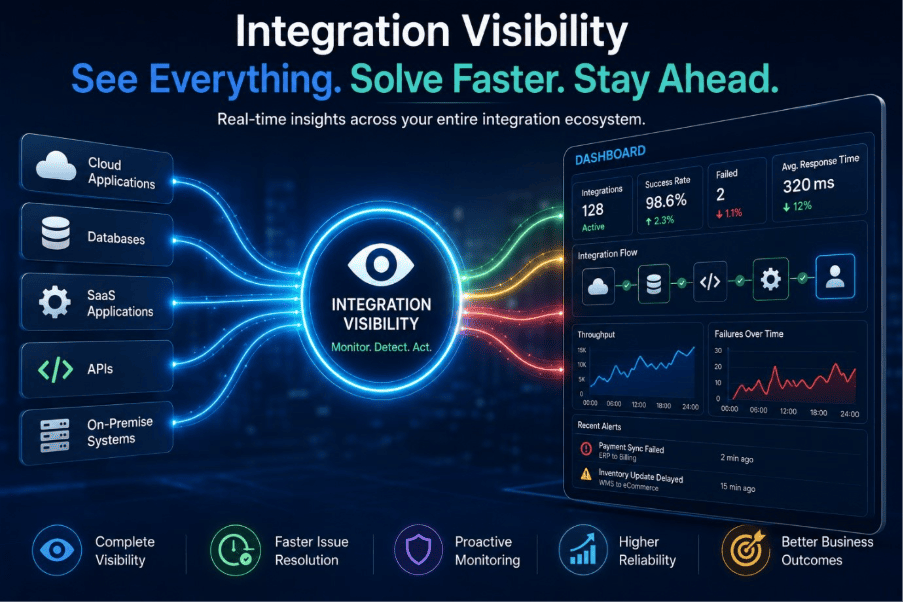
Organizations want the ability to understand what is happening across their connected systems at any given moment. They need access to performance metrics, workflow status, transaction histories, error notifications, and operational insights.
This level of visibility allows teams to identify issues before they affect users.
More importantly, it creates confidence in the reliability of business processes.
Visibility transforms integrations from hidden infrastructure into measurable business assets.
Instead of asking whether an integration exists, businesses are increasingly asking whether it is healthy, performing efficiently, and supporting operational goals.
This shift is redefining how organizations measure integration success.
Integration ecosystems are now following the same path.
Organizations want the ability to understand what is happening across their connected systems at any given moment. They need access to performance metrics, workflow status, transaction histories, error notifications, and operational insights.
This level of visibility allows teams to identify issues before they affect users.
More importantly, it creates confidence in the reliability of business processes.
Visibility transforms integrations from hidden infrastructure into measurable business assets.
Instead of asking whether an integration exists, businesses are increasingly asking whether it is healthy, performing efficiently, and supporting operational goals.
This shift is redefining how organizations measure integration success.
Streamline Your Inventory. Order Smartly.
Start Simplifying Your Orders with Any Connector
Better visibility leads to faster decisions
One of the most valuable outcomes of integration visibility is improved decision-making.
Business leaders increasingly depend on real-time information to guide operations, forecast performance, and respond to market changes.
When integrations are monitored effectively, organizations gain greater confidence in the quality and accuracy of their data.
This confidence enables faster decision-making because leaders spend less time validating information and more time acting on insights.
Operational teams also benefit from visibility.
Instead of manually investigating issues across multiple systems, teams can quickly identify the source of problems and resolve them before they affect larger workflows.
The result is improved efficiency, reduced downtime, and stronger operational performance.
When teams trust the flow of information, they can spend less time validating data and more time acting on it. That is where visibility moves from a technical feature to a business advantage.
In many ways, visibility serves as the bridge between integration and business intelligence.
Business leaders increasingly depend on real-time information to guide operations, forecast performance, and respond to market changes.
When integrations are monitored effectively, organizations gain greater confidence in the quality and accuracy of their data.
This confidence enables faster decision-making because leaders spend less time validating information and more time acting on insights.
Operational teams also benefit from visibility.
Instead of manually investigating issues across multiple systems, teams can quickly identify the source of problems and resolve them before they affect larger workflows.
The result is improved efficiency, reduced downtime, and stronger operational performance.
When teams trust the flow of information, they can spend less time validating data and more time acting on it. That is where visibility moves from a technical feature to a business advantage.
In many ways, visibility serves as the bridge between integration and business intelligence.
Visibility Enables Scalable Growth
As businesses grow, integration complexity increases.
New applications are added. New workflows are introduced. Additional data sources become part of the ecosystem.
Without proper monitoring, managing these connections becomes increasingly difficult.
Organizations that invest in integration visibility establish a stronger foundation for growth.
Rather than relying on manual oversight, they gain centralized insight into the health and performance of their integration environment.
This becomes particularly important for organizations operating across multiple locations, departments, or business units.
The ability to identify issues quickly and maintain operational consistency allows businesses to scale with greater confidence.
Growth becomes far easier to manage when teams can see which flows are healthy, which ones are slowing down, and where intervention is needed before problems spread.
New applications are added. New workflows are introduced. Additional data sources become part of the ecosystem.
Without proper monitoring, managing these connections becomes increasingly difficult.
Organizations that invest in integration visibility establish a stronger foundation for growth.
Rather than relying on manual oversight, they gain centralized insight into the health and performance of their integration environment.
This becomes particularly important for organizations operating across multiple locations, departments, or business units.
The ability to identify issues quickly and maintain operational consistency allows businesses to scale with greater confidence.
Growth becomes far easier to manage when teams can see which flows are healthy, which ones are slowing down, and where intervention is needed before problems spread.
The Future of IT Operations Is Proactive, Not Reactive
Traditional IT operations often focus on responding to problems after they occur.
The next generation of IT operations will focus on preventing those problems from happening in the first place.
Integration visibility plays a critical role in this evolution.
By providing real-time monitoring, alerts, diagnostics, and operational insights, organizations can identify risks early and take corrective action before business processes are affected.
This proactive approach reduces downtime, improves reliability, and strengthens trust across the organization.
The same philosophy is explored in How Integration Platforms Remove IT Bottlenecks, where operational efficiency improves when teams can identify and resolve issues before they become larger business challenges.
As integration ecosystems become more complex, visibility will become just as important as connectivity itself.
The next generation of IT operations will focus on preventing those problems from happening in the first place.
Integration visibility plays a critical role in this evolution.
By providing real-time monitoring, alerts, diagnostics, and operational insights, organizations can identify risks early and take corrective action before business processes are affected.
This proactive approach reduces downtime, improves reliability, and strengthens trust across the organization.
The same philosophy is explored in How Integration Platforms Remove IT Bottlenecks, where operational efficiency improves when teams can identify and resolve issues before they become larger business challenges.
As integration ecosystems become more complex, visibility will become just as important as connectivity itself.
How Any Connector Helps Businesses Gain Integration Visibility
Modern integrations should not operate as black boxes.
Organizations need visibility into how data moves, how workflows perform, and how systems interact across their digital ecosystem.
Any Connector helps businesses achieve this by providing a centralized integration platform designed for connectivity, reliability, and operational transparency. By simplifying integration management and improving visibility across connected systems, organizations can reduce risk, improve efficiency, and make more informed decisions.
Organizations looking to modernize their integration strategy should focus not only on connecting systems but also on monitoring them effectively. Visibility enables stronger governance, better performance, and greater confidence in business operations.
The future of IT operations will be defined by organizations that not only connect their systems but also understand and manage those connections effectively.
In a world where business depends on seamless data flow, visibility is no longer optional. It is becoming a strategic requirement.
Organizations need visibility into how data moves, how workflows perform, and how systems interact across their digital ecosystem.
Any Connector helps businesses achieve this by providing a centralized integration platform designed for connectivity, reliability, and operational transparency. By simplifying integration management and improving visibility across connected systems, organizations can reduce risk, improve efficiency, and make more informed decisions.
Organizations looking to modernize their integration strategy should focus not only on connecting systems but also on monitoring them effectively. Visibility enables stronger governance, better performance, and greater confidence in business operations.
The future of IT operations will be defined by organizations that not only connect their systems but also understand and manage those connections effectively.
In a world where business depends on seamless data flow, visibility is no longer optional. It is becoming a strategic requirement.
Recommended
it-operations