Introduction
In today’s digital economy, most businesses are not short on software. They are short on flow. Teams may have strong systems for sales, finance, HR, operations, and customer support, yet still lose time because those systems do not communicate well with one another. The result is familiar - duplicated effort, delayed decisions, fragmented workflows, and a customer experience that feels less seamless than it should.
For years, integration was treated as an IT task - important, but mostly invisible to the rest of the business. Today, that mindset is changing. More organizations are realizing that integration is not just about connecting applications behind the scenes. It is about creating the conditions for speed, resilience, better insight, and smarter growth.
The businesses pulling ahead are often not the ones with the biggest technology stacks. They are the ones that have built connected ecosystems where information moves cleanly across teams, processes, and platforms. When integration becomes part of business strategy instead of a last-minute fix, companies gain something powerful - the ability to move faster without creating more complexity.
For years, integration was treated as an IT task - important, but mostly invisible to the rest of the business. Today, that mindset is changing. More organizations are realizing that integration is not just about connecting applications behind the scenes. It is about creating the conditions for speed, resilience, better insight, and smarter growth.
The businesses pulling ahead are often not the ones with the biggest technology stacks. They are the ones that have built connected ecosystems where information moves cleanly across teams, processes, and platforms. When integration becomes part of business strategy instead of a last-minute fix, companies gain something powerful - the ability to move faster without creating more complexity.
Why Business Agility Depends on Connectivity
Markets are evolving faster than ever before. Customer expectations shift rapidly, new technologies emerge continuously, and competitive pressures demand constant adaptation. In this environment, agility has become one of the most valuable business capabilities.
However, agility is difficult to achieve when systems operate in isolation. Sales teams may be working with different information than finance teams. HR systems may not communicate effectively with payroll platforms. Operations teams may spend hours manually reconciling data from multiple applications before making decisions.
These disconnects create delays that slow the entire organization.
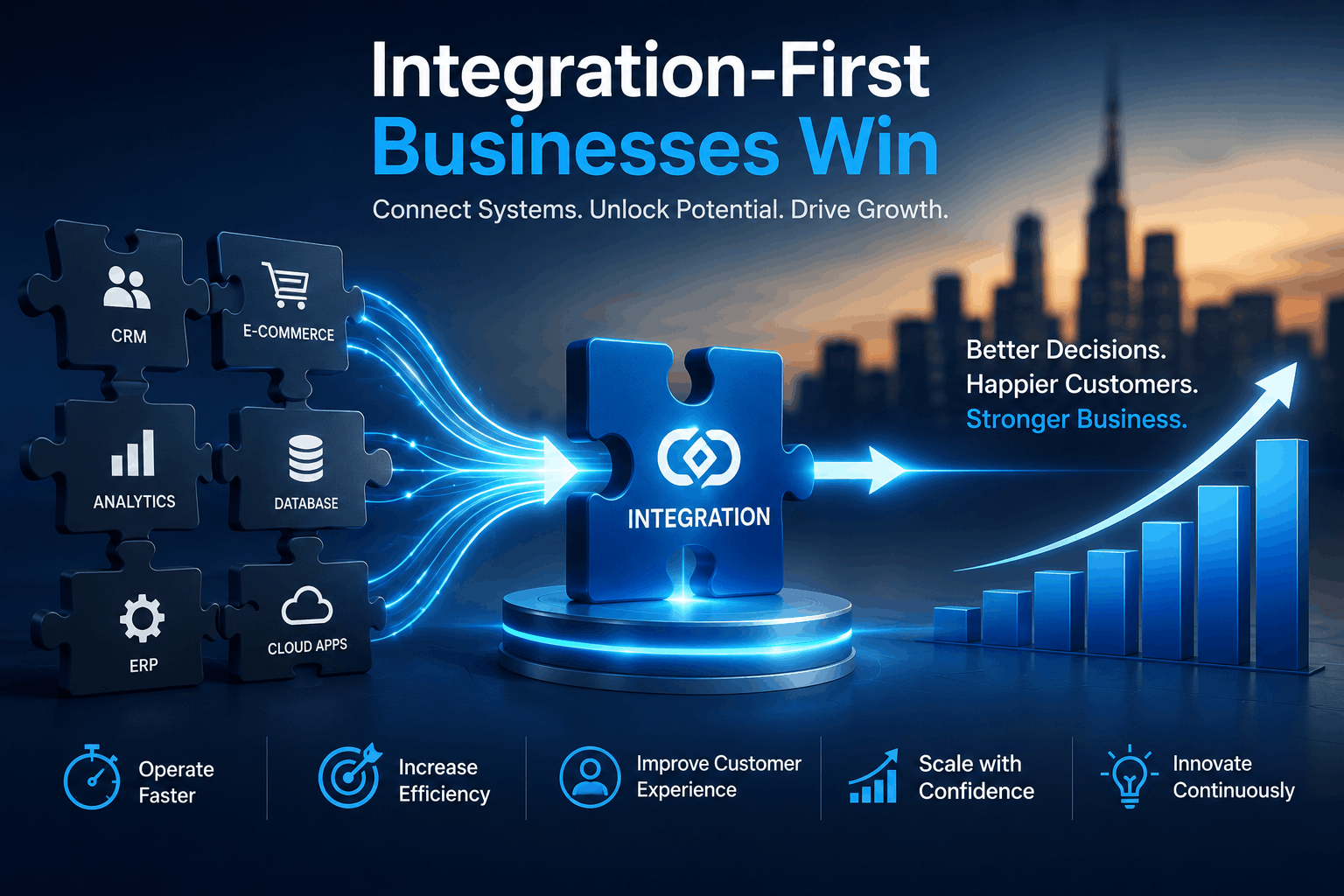
An integration-first approach removes these barriers by ensuring that critical information moves seamlessly between systems. When data flows automatically and accurately across the business, teams gain access to real-time insights and can respond more quickly to changing circumstances.
That is why an integration-first approach matter. When critical information moves automatically and accurately between systems, teams can act on real-time insight instead of waiting for updates, exports, or manual reconciliation. This is also the idea behind API-Led Connectivity - The Shift from Rigid Integrations to Flexible Systems, which explores how flexible integration models help businesses respond faster as operations and customer expectations evolve.
However, agility is difficult to achieve when systems operate in isolation. Sales teams may be working with different information than finance teams. HR systems may not communicate effectively with payroll platforms. Operations teams may spend hours manually reconciling data from multiple applications before making decisions.
These disconnects create delays that slow the entire organization.
An integration-first approach removes these barriers by ensuring that critical information moves seamlessly between systems. When data flows automatically and accurately across the business, teams gain access to real-time insights and can respond more quickly to changing circumstances.
That is why an integration-first approach matter. When critical information moves automatically and accurately between systems, teams can act on real-time insight instead of waiting for updates, exports, or manual reconciliation. This is also the idea behind API-Led Connectivity - The Shift from Rigid Integrations to Flexible Systems, which explores how flexible integration models help businesses respond faster as operations and customer expectations evolve.
Integration Is No Longer Just an IT Conversation
For many years, integration projects were initiated only after operational problems became apparent. A new application would be implemented, data silos would emerge, and eventually IT teams would be tasked with creating connections between systems.
This reactive approach often results in fragmented architectures, complex maintenance requirements, and increased operational costs.
Integration-first businesses take a fundamentally different approach. They evaluate connectivity as part of every technology decision. Rather than asking whether a system can perform a specific function, they also ask how effectively it will communicate with the rest of the business ecosystem.
This shift transforms integration from a technical concern into a strategic business consideration.
When leadership teams begin viewing integration through a business lens, the conversation changes. Instead of focusing solely on software features, organizations focus on operational efficiency, scalability, customer experience, and long-term adaptability. This business-led view of integration is closely connected to How Integration Platforms Remove IT Bottlenecks and Speed Up Delivery. When organizations reduce dependency on one-off, reactive integration work, they free teams to move faster while keeping governance and visibility intact.
This reactive approach often results in fragmented architectures, complex maintenance requirements, and increased operational costs.
Integration-first businesses take a fundamentally different approach. They evaluate connectivity as part of every technology decision. Rather than asking whether a system can perform a specific function, they also ask how effectively it will communicate with the rest of the business ecosystem.
This shift transforms integration from a technical concern into a strategic business consideration.
When leadership teams begin viewing integration through a business lens, the conversation changes. Instead of focusing solely on software features, organizations focus on operational efficiency, scalability, customer experience, and long-term adaptability. This business-led view of integration is closely connected to How Integration Platforms Remove IT Bottlenecks and Speed Up Delivery. When organizations reduce dependency on one-off, reactive integration work, they free teams to move faster while keeping governance and visibility intact.
Faster Decisions Become a Real Competitive Advantage
Every business decision depends on information. The speed and accuracy of that information often determine how effectively an organization can respond to opportunities and challenges.
Disconnected systems create delays in reporting, forecasting, and operational visibility. Teams spend valuable time gathering data from multiple sources rather than acting on insights.
Integration-first organizations eliminate much of this friction.
When applications, databases, and workflows are connected, information becomes accessible in real time. Decision-makers gain a more complete view of operations, enabling faster responses and more informed strategies.
This advantage extends beyond executive leadership. Frontline employees, managers, and operational teams also benefit from immediate access to accurate information.
As a result, the entire organization becomes more responsive and efficient.
In highly competitive industries, even small improvements in decision speed can have a significant impact on performance, customer satisfaction, and profitability.
Disconnected systems create delays in reporting, forecasting, and operational visibility. Teams spend valuable time gathering data from multiple sources rather than acting on insights.
Integration-first organizations eliminate much of this friction.
When applications, databases, and workflows are connected, information becomes accessible in real time. Decision-makers gain a more complete view of operations, enabling faster responses and more informed strategies.
This advantage extends beyond executive leadership. Frontline employees, managers, and operational teams also benefit from immediate access to accurate information.
As a result, the entire organization becomes more responsive and efficient.
In highly competitive industries, even small improvements in decision speed can have a significant impact on performance, customer satisfaction, and profitability.
Supporting Growth Without Increasing Complexity
Growth often introduces new challenges. As businesses expand, they adopt additional applications, enter new markets, onboard new vendors, and create more complex workflows.
Without a strong integration strategy, complexity grows alongside the business.
Many organizations eventually find themselves managing dozens of disconnected systems, each requiring manual processes and custom workarounds. What initially appeared manageable becomes increasingly difficult to maintain.
Integration-first businesses avoid this scenario by building connectivity into their growth strategy.
Instead of creating isolated technology investments, they establish a connected framework capable of supporting future expansion.
This approach reduces operational friction, simplifies technology management, and enables organizations to scale more efficiently.
The ability to add new systems without disrupting existing operations becomes a significant competitive advantage as business requirements evolve.
Without a strong integration strategy, complexity grows alongside the business.
Many organizations eventually find themselves managing dozens of disconnected systems, each requiring manual processes and custom workarounds. What initially appeared manageable becomes increasingly difficult to maintain.
Integration-first businesses avoid this scenario by building connectivity into their growth strategy.
Instead of creating isolated technology investments, they establish a connected framework capable of supporting future expansion.
This approach reduces operational friction, simplifies technology management, and enables organizations to scale more efficiently.
The ability to add new systems without disrupting existing operations becomes a significant competitive advantage as business requirements evolve.
Streamline Your Inventory. Order Smartly.
Start Simplifying Your Orders with Any Connector
Improving Customer Experience Through Connected Operations
Customer expectations continue to rise across every industry. Customers expect accurate information, faster service, and seamless experiences regardless of how they interact with a business.
Delivering these experiences requires more than customer-facing technology. It requires connected operations behind the scenes.
When CRM platforms, support systems, finance applications, inventory tools, and operational workflows communicate effectively, organizations can provide faster and more consistent service.
Customers benefit from improved accuracy, quicker resolutions, and a more personalized experience.
This is one of the most overlooked benefits of integration.
While customers rarely see the integrations themselves, they directly experience the outcomes of connected systems.
Businesses that prioritize integration are often better equipped to meet customer expectations and build long-term loyalty.
Delivering these experiences requires more than customer-facing technology. It requires connected operations behind the scenes.
When CRM platforms, support systems, finance applications, inventory tools, and operational workflows communicate effectively, organizations can provide faster and more consistent service.
Customers benefit from improved accuracy, quicker resolutions, and a more personalized experience.
This is one of the most overlooked benefits of integration.
While customers rarely see the integrations themselves, they directly experience the outcomes of connected systems.
Businesses that prioritize integration are often better equipped to meet customer expectations and build long-term loyalty.
Building a Foundation for Innovation
Innovation requires flexibility.
Organizations that want to introduce new services, test new business models, or adopt emerging technologies need an infrastructure capable of supporting change.
Disconnected systems make innovation more difficult because every new initiative requires additional integration work, manual processes, and technical resources.
Integration-first businesses create an environment where experimentation becomes easier.
New applications can be connected more quickly. Data can be shared across systems without extensive development efforts. Workflows can be adapted without disrupting existing operations.
Innovation becomes far easier when a business does not have to rebuild its infrastructure every time a new idea appears. A modern integration foundation makes it easier to connect new applications, share data where it is needed, and adapt workflows without disrupting the rest of the operation. That flexibility is one reason connected businesses are better positioned to test ideas, launch services faster, and respond confidently to changing customer demands.
This flexibility allows organizations to innovate faster while reducing implementation risk.
In an increasingly competitive marketplace, the ability to transform ideas into action quickly can become a major differentiator.
Organizations that want to introduce new services, test new business models, or adopt emerging technologies need an infrastructure capable of supporting change.
Disconnected systems make innovation more difficult because every new initiative requires additional integration work, manual processes, and technical resources.
Integration-first businesses create an environment where experimentation becomes easier.
New applications can be connected more quickly. Data can be shared across systems without extensive development efforts. Workflows can be adapted without disrupting existing operations.
Innovation becomes far easier when a business does not have to rebuild its infrastructure every time a new idea appears. A modern integration foundation makes it easier to connect new applications, share data where it is needed, and adapt workflows without disrupting the rest of the operation. That flexibility is one reason connected businesses are better positioned to test ideas, launch services faster, and respond confidently to changing customer demands.
This flexibility allows organizations to innovate faster while reducing implementation risk.
In an increasingly competitive marketplace, the ability to transform ideas into action quickly can become a major differentiator.
How Any Connector Helps Businesses Become Integration-First
Becoming an integration-first organization requires more than connecting applications. It requires a platform that simplifies connectivity, supports scalability, and enables businesses to adapt as requirements evolve.
Any Connector helps businesses create connected ecosystems by simplifying integrations across applications, systems, and workflows. Instead of layering more complexity onto an already fragmented environment, organizations can create cleaner data flow, reduce manual effort, and make better decisions with more confidence.
For organizations investing in digital transformation, integration should be viewed as a growth enabler, not just a technical requirement. A connected foundation supports faster execution, smoother expansion, stronger customer experiences, and a more adaptable business model over time.
Any Connector helps businesses create connected ecosystems by simplifying integrations across applications, systems, and workflows. Instead of layering more complexity onto an already fragmented environment, organizations can create cleaner data flow, reduce manual effort, and make better decisions with more confidence.
For organizations investing in digital transformation, integration should be viewed as a growth enabler, not just a technical requirement. A connected foundation supports faster execution, smoother expansion, stronger customer experiences, and a more adaptable business model over time.
Conclusion
The companies gaining an edge today are the ones treating integration as a strategic capability. When systems are connected, teams move faster, decisions improve, and growth becomes easier to sustain. In a market where speed and adaptability matter, integration-first thinking is no longer optional; it is a competitive advantage.
Any Connector gives businesses the foundation to make that shift with scalable integrations, workflow automation, and seamless connectivity across the tools they rely on every day.
Any Connector gives businesses the foundation to make that shift with scalable integrations, workflow automation, and seamless connectivity across the tools they rely on every day.
Recommended
digital-transformation
digital-transformation