Introduction
For years, integration success was measured by a simple question - did the data get from one system to another? If customer records synced, employee information moved into payroll, inventory updates reached the right application, and reports refreshed on schedule, the job was considered done.
That definition no longer matches how modern businesses operate. Today’s organizations rely on a growing mix of cloud applications, APIs, automation tools, analytics platforms, and department-specific systems. In that environment, moving information is only the starting point. The real question is what happens after the data arrives.
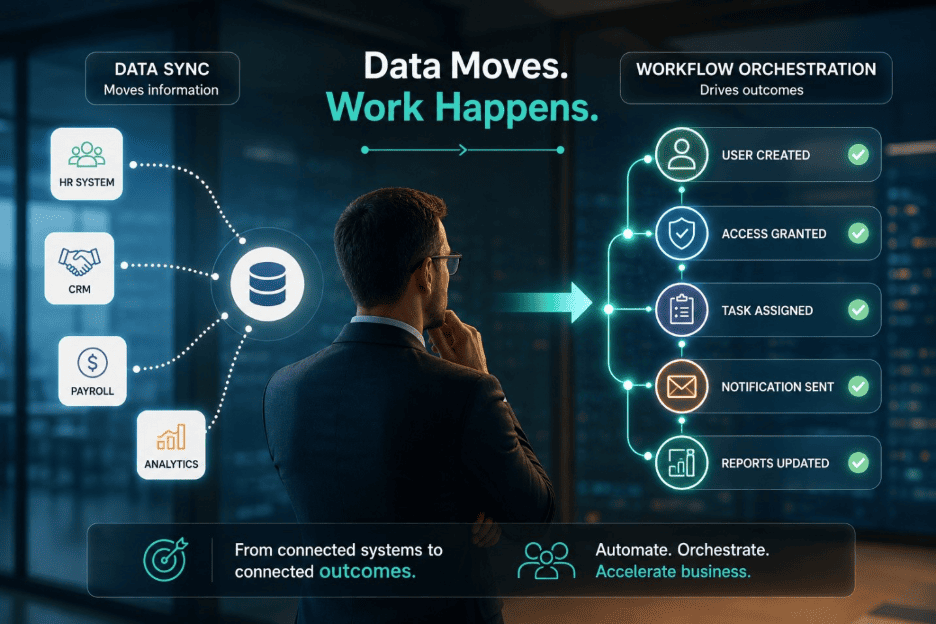
A synced record does not automatically complete a business process. It does not notify the right person, assign the next task, trigger an approval, update a dashboard, or resolve an exception. Data synchronization keeps systems aligned, but workflow orchestration helps the business move.
That definition no longer matches how modern businesses operate. Today’s organizations rely on a growing mix of cloud applications, APIs, automation tools, analytics platforms, and department-specific systems. In that environment, moving information is only the starting point. The real question is what happens after the data arrives.
A synced record does not automatically complete a business process. It does not notify the right person, assign the next task, trigger an approval, update a dashboard, or resolve an exception. Data synchronization keeps systems aligned, but workflow orchestration helps the business move.
Synchronization Is Still Important, but It Is Not the Finish Line
Data synchronization remains a critical foundation for digital operations. It reduces duplicate entry, improves consistency, and gives teams access to information where they need it. Without synchronization, departments are left reconciling spreadsheets, chasing updates, and making decisions from incomplete records.
The limitation is that synchronization answers only one operational question - is the data available? It does not define the next step. It does not understand timing, business rules, dependencies, exceptions, or outcomes. A system may receive the right data at the right time and still leave people to manually push the process forward.
The limitation is that synchronization answers only one operational question - is the data available? It does not define the next step. It does not understand timing, business rules, dependencies, exceptions, or outcomes. A system may receive the right data at the right time and still leave people to manually push the process forward.
The Gap Between Connected Data and Connected Work
Consider a new employee onboarding process. An HR platform can successfully sync the employee record into payroll, scheduling, security, and communication tools. From a data perspective, everything looks connected.
But the business still needs more than synced fields. The manager needs to be notified. Training tasks need to be assigned. Payroll setup may need verification. System permissions must be granted. If those actions depend on someone remembering each step, the process is still fragile.
This is the gap many organizations feel every day. Systems are connected yet work still slows down because the process around the data is not coordinated. The result is a familiar pattern - manual follow-ups, delayed approvals, missed handoffs, inconsistent reporting, and teams spending too much time managing routine activity instead of improving outcomes.
But the business still needs more than synced fields. The manager needs to be notified. Training tasks need to be assigned. Payroll setup may need verification. System permissions must be granted. If those actions depend on someone remembering each step, the process is still fragile.
This is the gap many organizations feel every day. Systems are connected yet work still slows down because the process around the data is not coordinated. The result is a familiar pattern - manual follow-ups, delayed approvals, missed handoffs, inconsistent reporting, and teams spending too much time managing routine activity instead of improving outcomes.
Workflow Orchestration Turns Data Movement into Business Momentum
Workflow orchestration adds the operating logic that simple synchronization does not provide. It coordinates systems, data, people, and business rules so that actions happen in the right order and at the right time. Instead of treating integration as a series of disconnected transfers, orchestration turns connected applications into a coordinated operating environment.
Imagine a customer order being completed. In a synchronized environment, order data may move into an ERP or reporting system. In an orchestrated environment, that same event can update inventory, alert fulfilment, generate an invoice, refresh dashboards, notify the customer, and escalate exceptions automatically. The difference is not just technical. It changes how fast the business can respond.
This is why integration strategy is moving beyond point-to-point data exchange. As Any Connector explains in API-Led Connectivity - The Shift from Rigid Integrations to Flexible Systems, reusable and adaptable integration layers help businesses respond faster as systems, processes, and requirements change.
Imagine a customer order being completed. In a synchronized environment, order data may move into an ERP or reporting system. In an orchestrated environment, that same event can update inventory, alert fulfilment, generate an invoice, refresh dashboards, notify the customer, and escalate exceptions automatically. The difference is not just technical. It changes how fast the business can respond.
This is why integration strategy is moving beyond point-to-point data exchange. As Any Connector explains in API-Led Connectivity - The Shift from Rigid Integrations to Flexible Systems, reusable and adaptable integration layers help businesses respond faster as systems, processes, and requirements change.
The Hidden Cost of Manual Process Gaps
One of the most expensive integration problems is also one of the easiest to overlook. When data syncs correctly, leaders may assume the process is working. But employees often continue to monitor queues, chase approvals, correct exceptions, copy data into secondary systems, and validate reports manually.
Those small interventions compound over time. A five-minute workaround repeated across teams, locations, and workflows becomes a meaningful operational cost. It also increases risk. Every manual handoff creates another opportunity for delay, inconsistency, or error.
The problem is rarely a lack of data. It is a lack of automation around that data. This is where modern integration platforms become especially valuable. In How Integration Platforms Remove IT Bottlenecks and Speed Up Delivery, Any Connector highlights how platform-led integration can reduce repetitive build work, improve governance, and help teams move faster without losing control.
Those small interventions compound over time. A five-minute workaround repeated across teams, locations, and workflows becomes a meaningful operational cost. It also increases risk. Every manual handoff creates another opportunity for delay, inconsistency, or error.
The problem is rarely a lack of data. It is a lack of automation around that data. This is where modern integration platforms become especially valuable. In How Integration Platforms Remove IT Bottlenecks and Speed Up Delivery, Any Connector highlights how platform-led integration can reduce repetitive build work, improve governance, and help teams move faster without losing control.
Streamline Your Inventory. Order Smartly.
Start Simplifying Your Orders with Any Connector
Business Agility Depends on What Happens Next
Agility is not just the ability to see information quickly. It is the ability to act on that information quickly. Data synchronization improves visibility, but orchestration gives teams the ability to respond to new events, changing priorities, and operational exceptions with far less friction.
When workflows are orchestrated, businesses can introduce new applications, adjust approvals, modify routing logic, and scale processes without rebuilding every connection from scratch. This makes change less disruptive and experimentation more practical.
That flexibility matters because modern teams are under constant pressure to test new ideas, improve customer experiences, and launch initiatives faster. Any Connector explores this mindset in How Integration Platforms Help Businesses Experiment Faster, where connected systems create the foundation for faster testing, cleaner execution, and lower-risk change.
When workflows are orchestrated, businesses can introduce new applications, adjust approvals, modify routing logic, and scale processes without rebuilding every connection from scratch. This makes change less disruptive and experimentation more practical.
That flexibility matters because modern teams are under constant pressure to test new ideas, improve customer experiences, and launch initiatives faster. Any Connector explores this mindset in How Integration Platforms Help Businesses Experiment Faster, where connected systems create the foundation for faster testing, cleaner execution, and lower-risk change.
From Connected Data to Connected Operations
The next phase of integration is not about asking whether systems can share information. It is about asking whether systems can work together in a way that supports the business outcome.
Can a customer issue trigger the right support workflow automatically? Can a staffing change update downstream systems without manual follow-up? Can a finance exception route to the right approver before it delays closing? Can leadership trust that the workflow is not only connected, but observable and controllable?
These questions reflect a broader shift in digital transformation. Integration is no longer a back-office technical requirement. It is becoming a strategic capability that affects speed, efficiency, customer experience, employee productivity, and scalability.
Can a customer issue trigger the right support workflow automatically? Can a staffing change update downstream systems without manual follow-up? Can a finance exception route to the right approver before it delays closing? Can leadership trust that the workflow is not only connected, but observable and controllable?
These questions reflect a broader shift in digital transformation. Integration is no longer a back-office technical requirement. It is becoming a strategic capability that affects speed, efficiency, customer experience, employee productivity, and scalability.
How Any Connector Helps Businesses Move Beyond Synchronization
Any Connector helps organizations move beyond basic data synchronization by connecting applications, automating workflows, and supporting process orchestration across business systems. The goal is not simply to move data from one platform to another. The goal is to help teams reduce manual effort, improve operational consistency, and create workflows that scale as the business grows.
For businesses building a more connected operating model, synchronization is the foundation. Orchestration is the next step. It is what turns integrations into action, visibility into control, and connected systems into connected operations.
Ready to move from data movement to business momentum? Any Connector can help you connect systems, automate workflows, and build a more agile integration foundation for the way your business operates today.
For businesses building a more connected operating model, synchronization is the foundation. Orchestration is the next step. It is what turns integrations into action, visibility into control, and connected systems into connected operations.
Ready to move from data movement to business momentum? Any Connector can help you connect systems, automate workflows, and build a more agile integration foundation for the way your business operates today.
Recommended
data-integration