Introduction
Most integration projects begin with a simple observation - something that should be automatic is still painfully manual.
Maybe customer data lives in two places. Maybe payroll changes require copy‑pasting between systems. Maybe an operations team is exporting spreadsheets every Monday like it’s a ritual.
Then the request becomes a ticket. The ticket joins a backlog. And suddenly a ‘quick integration’ turns into a six‑week waiting period.
If that sounds familiar, you’re not alone. Modern businesses add tools faster than most IT teams can connect them. And when every integration request funnels through the same narrow pipeline, delivery speed suffers, no matter how capable the IT team is.
The fix isn’t to push IT harder. The fix is to change the model. Centralized, low‑code integration platforms reduce the dependency on IT for every routine change, while keeping the guardrails that protect stability, security, and compliance.
"The fastest teams don’t eliminate IT oversight; they eliminate the need for IT to rebuild the same integration work over and over."
Maybe customer data lives in two places. Maybe payroll changes require copy‑pasting between systems. Maybe an operations team is exporting spreadsheets every Monday like it’s a ritual.
Then the request becomes a ticket. The ticket joins a backlog. And suddenly a ‘quick integration’ turns into a six‑week waiting period.
If that sounds familiar, you’re not alone. Modern businesses add tools faster than most IT teams can connect them. And when every integration request funnels through the same narrow pipeline, delivery speed suffers, no matter how capable the IT team is.
The fix isn’t to push IT harder. The fix is to change the model. Centralized, low‑code integration platforms reduce the dependency on IT for every routine change, while keeping the guardrails that protect stability, security, and compliance.
"The fastest teams don’t eliminate IT oversight; they eliminate the need for IT to rebuild the same integration work over and over."
Why IT Becomes the Bottleneck Even When the Team Is Great
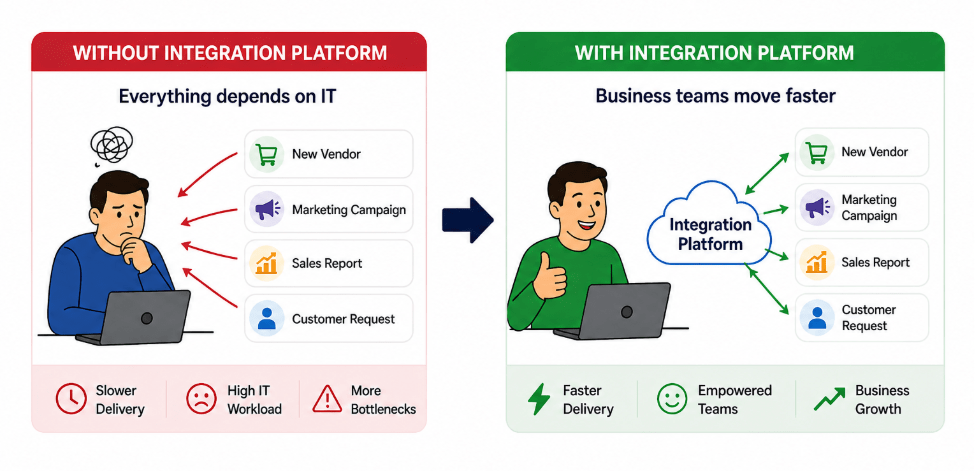
IT bottlenecks are rarely caused by lack of effort. They’re caused by how traditional integrations are built.
In a custom approach, every connection is a small software project - credentials, API contracts, authentication, data mapping, error handling, environment testing, deployment, monitoring plus ongoing maintenance every time a vendor changes something.
Now multiply that by ten departments, each with their own applications, deadlines, and priorities. The queue fills up fast. Easy requests sit behind hard requests. And business teams create workarounds that quietly become permanent.
The result is real business cost - delayed initiatives, manual rework, inconsistent data, and teams that can’t move at the speed the market demands.
In a custom approach, every connection is a small software project - credentials, API contracts, authentication, data mapping, error handling, environment testing, deployment, monitoring plus ongoing maintenance every time a vendor changes something.
Now multiply that by ten departments, each with their own applications, deadlines, and priorities. The queue fills up fast. Easy requests sit behind hard requests. And business teams create workarounds that quietly become permanent.
The result is real business cost - delayed initiatives, manual rework, inconsistent data, and teams that can’t move at the speed the market demands.
What a Centralized Integration Platform Actually Changes
A centralized integration platform consolidates connections into one managed environment. Think of it as an integration layer that sits between the tools you run and the workflows you want.
Instead of building integrations in isolation (each with its own logic, credentials, and maintenance burden), teams build and manage data flows from a single hub where behavior is consistent and observable.
The low‑code piece matters because it changes who can safely do what. Business operators and analysts - people who understand the workflow best can configure data movement without writing and maintaining custom code. The platform handles the technical heavy lifting, while the user focuses on intent - what data moves, when it moves, and what should happen if something fails.
The IT team still plays a critical role, but it becomes higher leverage. Rather than implementing every request, IT sets standards, defines permissions, approves sensitive connections, and hardens the platform for scale. Routine work moves forward without waiting for developer cycles.
Instead of building integrations in isolation (each with its own logic, credentials, and maintenance burden), teams build and manage data flows from a single hub where behavior is consistent and observable.
The low‑code piece matters because it changes who can safely do what. Business operators and analysts - people who understand the workflow best can configure data movement without writing and maintaining custom code. The platform handles the technical heavy lifting, while the user focuses on intent - what data moves, when it moves, and what should happen if something fails.
The IT team still plays a critical role, but it becomes higher leverage. Rather than implementing every request, IT sets standards, defines permissions, approves sensitive connections, and hardens the platform for scale. Routine work moves forward without waiting for developer cycles.
Speed Without Sacrificing Control
The moment you say ‘non‑developers can build integrations,’ a fair concern comes up - security.
A well‑designed integration platform doesn’t solve speed by removing controls, it solves speed by centralizing them. Business users can build within guardrails, but access, credentials, and audit trails remain managed in one place.
In practice, that means role‑based permissions, centralized credential management, standardized logging, and repeatable deployment patterns. You get faster execution without the ‘everyone has root access’ chaos.
If security is top of mind, this deeper dive is worth bookmarking - Secure API Integrations in Modern Enterprises.
A well‑designed integration platform doesn’t solve speed by removing controls, it solves speed by centralizing them. Business users can build within guardrails, but access, credentials, and audit trails remain managed in one place.
In practice, that means role‑based permissions, centralized credential management, standardized logging, and repeatable deployment patterns. You get faster execution without the ‘everyone has root access’ chaos.
If security is top of mind, this deeper dive is worth bookmarking - Secure API Integrations in Modern Enterprises.
From Integration Sprawl to a Scalable Foundation
Many organizations still rely on point‑to‑point connections and custom links between two specific tools. They work until they don’t.
The problem is compounding complexity. Every new application multiplies the number of connections you have to build and maintain. Every vendor update becomes a potential breaking change. Over time, integration becomes a web that’s hard to understand, harder to monitor, and expensive to change.
A platform‑led model simplifies the architecture. Instead of connecting each system to every other system, you connect systems to the platform once, then manage the data flows centrally. That reduces duplication, improves visibility, and makes it easier to standardize how your business moves information.
The hidden benefit is clarity. When something fails, you can see where it failed. When data changes, you can trace what happened. Visibility is a feature you only truly value the day something breaks.
The problem is compounding complexity. Every new application multiplies the number of connections you have to build and maintain. Every vendor update becomes a potential breaking change. Over time, integration becomes a web that’s hard to understand, harder to monitor, and expensive to change.
A platform‑led model simplifies the architecture. Instead of connecting each system to every other system, you connect systems to the platform once, then manage the data flows centrally. That reduces duplication, improves visibility, and makes it easier to standardize how your business moves information.
The hidden benefit is clarity. When something fails, you can see where it failed. When data changes, you can trace what happened. Visibility is a feature you only truly value the day something breaks.
Streamline Your Inventory. Order Smartly.
Start Simplifying Your Orders with Any Connector
What Delivery Speed Looks Like in the Real World
When you reduce IT bottlenecks, the downstream effects are immediate.
Integrations that used to take weeks can move in days. New tools can be onboarded faster because the integration layer is already in place. Business teams spend less time exporting, importing, and reconciling data and more time acting on it.
This is one reason integration ROI is often underestimated. The payoff isn’t only fewer hours spent on manual work. It’s faster launches, fewer operational surprises, and decision‑making built on data that actually matches across systems.
For a practical breakdown of this broader ROI (beyond pure cost savings), read - The Real ROI of Integration Platforms (Beyond Cost Savings)
Integrations that used to take weeks can move in days. New tools can be onboarded faster because the integration layer is already in place. Business teams spend less time exporting, importing, and reconciling data and more time acting on it.
This is one reason integration ROI is often underestimated. The payoff isn’t only fewer hours spent on manual work. It’s faster launches, fewer operational surprises, and decision‑making built on data that actually matches across systems.
For a practical breakdown of this broader ROI (beyond pure cost savings), read - The Real ROI of Integration Platforms (Beyond Cost Savings)
Timing Matters - Real‑Time vs. Right‑Time
Not every integration needs to be instant. And not every workflow should wait for an overnight batch.
The most reliable integration strategies match timing to the job. Event‑driven flows are ideal when immediacy protects revenue or trust. Scheduled flows are ideal when completeness and control matter more than seconds.
Choosing the right model reduces load, avoids noisy failures, and keeps data movement efficient.
If you’re designing integrations and debating real‑time vs. scheduled, this guide is an excellent reference - Right‑Time Integrations - Event‑Driven vs. Scheduled (and When Each Wins)
The most reliable integration strategies match timing to the job. Event‑driven flows are ideal when immediacy protects revenue or trust. Scheduled flows are ideal when completeness and control matter more than seconds.
Choosing the right model reduces load, avoids noisy failures, and keeps data movement efficient.
If you’re designing integrations and debating real‑time vs. scheduled, this guide is an excellent reference - Right‑Time Integrations - Event‑Driven vs. Scheduled (and When Each Wins)
A Quick Self‑Check - Are You Feeling the Bottleneck?
If integrations are slowing your team down, the symptoms usually show up in predictable ways. Ask yourself:
• Does a ‘small’ integration request routinely take weeks?
• Do teams rely on spreadsheets or manual checks to confirm reports are right?
• Does the business avoid changing tools because integrations might break?
• When something fails, is it hard to tell where the failure happened?
• Are credentials and API access scattered across people and projects?
If you answer yes to more than one, the issue is likely structural, not individual. And it’s exactly what centralized integration platforms are designed to fix.
• Does a ‘small’ integration request routinely take weeks?
• Do teams rely on spreadsheets or manual checks to confirm reports are right?
• Does the business avoid changing tools because integrations might break?
• When something fails, is it hard to tell where the failure happened?
• Are credentials and API access scattered across people and projects?
If you answer yes to more than one, the issue is likely structural, not individual. And it’s exactly what centralized integration platforms are designed to fix.
The Bottom Line
Integration has moved from ‘IT plumbing’ to core business infrastructure. The organizations that get it right move faster, automate more confidently, and spend less time patching gaps with manual work.
IT bottlenecks aren’t inevitable. With a centralized, low‑code integration platform, IT keeps governance where it belongs while the business gains the ability to ship changes without waiting in line.
If your backlog keeps growing and your tech stack keeps expanding, it may be time to take a hard look at your integration layer and whether it’s helping you scale or quietly slowing you down.
IT bottlenecks aren’t inevitable. With a centralized, low‑code integration platform, IT keeps governance where it belongs while the business gains the ability to ship changes without waiting in line.
If your backlog keeps growing and your tech stack keeps expanding, it may be time to take a hard look at your integration layer and whether it’s helping you scale or quietly slowing you down.
Ready to unblock delivery?
If you want to see what a platform‑led integration layer looks like in practice, Any Connector can help you centralize connections, reduce integration sprawl, and accelerate delivery without sacrificing governance.
Explore Any Connector or browse more integration insights on our blog.
Explore Any Connector or browse more integration insights on our blog.
Recommended
integration-platforms
integration-platforms
integration-platforms