Introduction
Integration used to be the quiet, behind-the-scenes job of moving data from one system to another. Connect the apps, sync the records, automate the file transfer and call it done.
That model worked when business stacks were smaller and decisions could wait for the next scheduled update. But today, it’s a bottleneck.
Most teams now operate across an expanding ecosystem - CRM, ERP, HR, payroll, ecommerce, customer support, finance, analytics, and industry-specific tools. Each platform creates valuable signals. The problem is that when those signals stay trapped in separate systems, the organization loses time, visibility, and confidence.
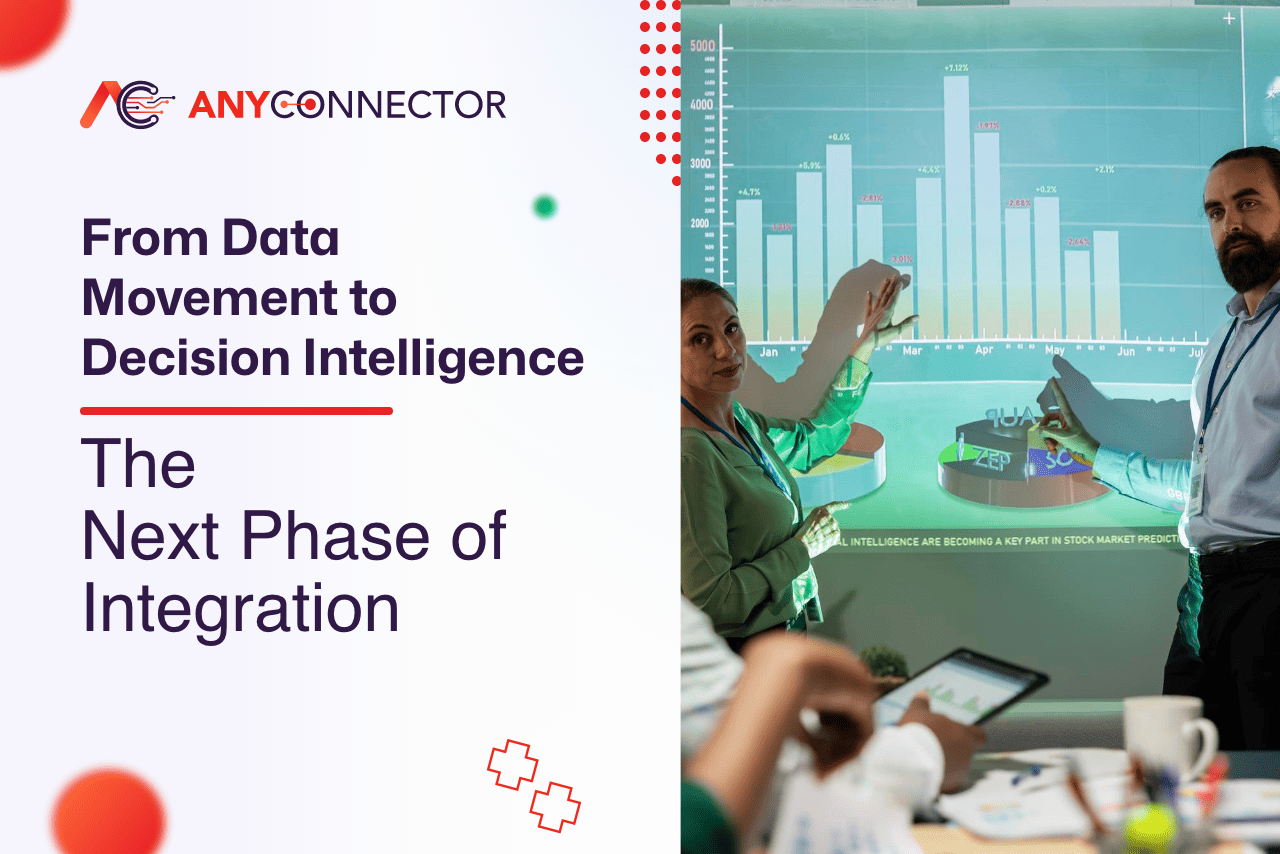
This is why integration has entered a new phase. It’s no longer just about transferring data; it’s about turning connected information into timely insights and automated next steps. In other words - moving from data movement to decision intelligence.
That model worked when business stacks were smaller and decisions could wait for the next scheduled update. But today, it’s a bottleneck.
Most teams now operate across an expanding ecosystem - CRM, ERP, HR, payroll, ecommerce, customer support, finance, analytics, and industry-specific tools. Each platform creates valuable signals. The problem is that when those signals stay trapped in separate systems, the organization loses time, visibility, and confidence.
This is why integration has entered a new phase. It’s no longer just about transferring data; it’s about turning connected information into timely insights and automated next steps. In other words - moving from data movement to decision intelligence.
Why “just moving data” doesn’t create clarity
A lot of companies already have integrations in place. Sales flows into finance. Employee updates sync to payroll. Orders land in reporting. Those connections help but they often stop at the point where strategy begins.
Because data transfer isn’t the same thing as understanding. If the data arrives late, arrives incomplete, or lives in a place no one can use, leadership still ends up guessing or waiting.
That’s how you get familiar pain points - finance reviewing an outdated pipeline, operations staffing against yesterday’s demand, or HR chasing payroll exceptions caused by stale workforce records. It’s not a lack of data; it’s a lack of connected, current, and actionable data.
Decision intelligence closes that gap. It’s what happens when integrations don’t just pass information along, but help the business respond faster, spot patterns sooner, and trigger the right workflow at the moment it matters.
Because data transfer isn’t the same thing as understanding. If the data arrives late, arrives incomplete, or lives in a place no one can use, leadership still ends up guessing or waiting.
That’s how you get familiar pain points - finance reviewing an outdated pipeline, operations staffing against yesterday’s demand, or HR chasing payroll exceptions caused by stale workforce records. It’s not a lack of data; it’s a lack of connected, current, and actionable data.
Decision intelligence closes that gap. It’s what happens when integrations don’t just pass information along, but help the business respond faster, spot patterns sooner, and trigger the right workflow at the moment it matters.
Real-time is helpful but “right-time” is the real advantage
Speed has become a competitive advantage. And yet many integrations still run on schedules - hourly, nightly, weekly because that’s how they were built years ago.
The result shows up in small moments that create big friction - support can’t see the latest order details, payroll changes miss a cycle, and dashboards look confident until you realize they’re based on yesterday’s reality.
Those aren’t technology failures. They’re timing failures.
When integrations respond to events as they happen - sale closed, payment processed, inventory updated and your systems stay aligned in the moment. Teams make decisions based on what’s happening now, not what finally synced after a delay.
If you’re weighing event-driven vs scheduled approaches, Right-Time Integrations - Event-Driven vs Scheduled (and When Each Wins) breaks down when each model makes sense and why the best teams use both.
The result shows up in small moments that create big friction - support can’t see the latest order details, payroll changes miss a cycle, and dashboards look confident until you realize they’re based on yesterday’s reality.
Those aren’t technology failures. They’re timing failures.
When integrations respond to events as they happen - sale closed, payment processed, inventory updated and your systems stay aligned in the moment. Teams make decisions based on what’s happening now, not what finally synced after a delay.
If you’re weighing event-driven vs scheduled approaches, Right-Time Integrations - Event-Driven vs Scheduled (and When Each Wins) breaks down when each model makes sense and why the best teams use both.
Why platform-led integration beats integration sprawl
As companies add tools, integrations tend to multiply in the messiest way possible - one-off connections built quickly to solve a single problem. Over time, “just one more integration” becomes a web that’s hard to troubleshoot, expensive to change, and risky to scale.
A platform-led approach replaces that web with a cleaner foundation.
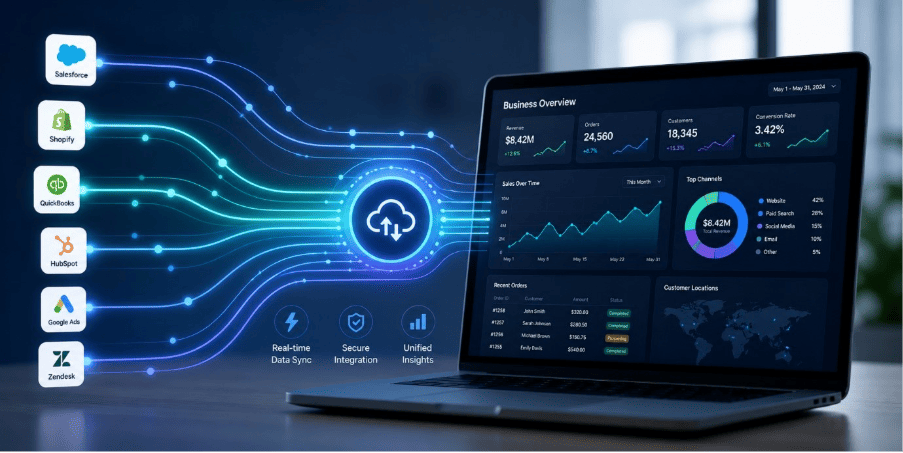
Instead of building and maintaining separate point-to-point connections between every pair of systems, teams use a centralized integration layer to manage workflows, data movement, monitoring, and governance in one place. That reduces complexity while improving reliability and control.
This is where platforms like Any Connector fit - giving growing teams an easier way to build, scale, and manage integrations without piling up fragile custom work.
When you standardize integration on a shared platform, adding a new system stops feeling like a rebuild and starts feeling like an extension.
A platform-led approach replaces that web with a cleaner foundation.
Instead of building and maintaining separate point-to-point connections between every pair of systems, teams use a centralized integration layer to manage workflows, data movement, monitoring, and governance in one place. That reduces complexity while improving reliability and control.
This is where platforms like Any Connector fit - giving growing teams an easier way to build, scale, and manage integrations without piling up fragile custom work.
When you standardize integration on a shared platform, adding a new system stops feeling like a rebuild and starts feeling like an extension.
What decision intelligence looks like across the business
When integrations become intelligent, the impact shows up far beyond IT. It changes how work gets done and how quickly teams can act across departments.
In HR and payroll, it means fewer exceptions and fewer last-minute fixes. New hires, role changes, pay updates, and terminations flow through cleanly, so payroll runs on aligned data instead of spreadsheets and rework.
In sales and customer success, it creates a truer customer picture. Purchase history, service requests, and account activity show up where teams work, so outreach is timely, support is faster, and handoffs are smoother.
In finance and operations, connected data improves forecasting, speeds approvals, and surfaces anomalies earlier without waiting on manually compiled reports.
And at the executive level, decision-makers get a single, connected view of performance which is less debating whose spreadsheet is right, more acting on what the business is telling them.
When systems agree, teams move. When systems argue, teams wait.
In HR and payroll, it means fewer exceptions and fewer last-minute fixes. New hires, role changes, pay updates, and terminations flow through cleanly, so payroll runs on aligned data instead of spreadsheets and rework.
In sales and customer success, it creates a truer customer picture. Purchase history, service requests, and account activity show up where teams work, so outreach is timely, support is faster, and handoffs are smoother.
In finance and operations, connected data improves forecasting, speeds approvals, and surfaces anomalies earlier without waiting on manually compiled reports.
And at the executive level, decision-makers get a single, connected view of performance which is less debating whose spreadsheet is right, more acting on what the business is telling them.
When systems agree, teams move. When systems argue, teams wait.
Streamline Your Inventory. Order Smartly.
Start Simplifying Your Orders with Any Connector
Security can’t be an afterthought
As integration becomes more central to operations, it also becomes more central to risk. Every connected system adds another surface area, another credential, endpoint, mapping, and workflow that needs to be protected and monitored.
That’s why modern integration platforms bake in secure APIs, controlled access, encryption, audit trails, and governance from day one. If security is bolted on later, teams usually discover the gaps the hard way during an incident, an audit, or an urgent vendor change.
For a practical look at what “secure by design” means in an integration-heavy environment, see Secure API Integrations in Modern Enterprises.
With Any Connector, teams can improve connectivity while keeping the visibility and control enterprise environments require.
That’s why modern integration platforms bake in secure APIs, controlled access, encryption, audit trails, and governance from day one. If security is bolted on later, teams usually discover the gaps the hard way during an incident, an audit, or an urgent vendor change.
For a practical look at what “secure by design” means in an integration-heavy environment, see Secure API Integrations in Modern Enterprises.
With Any Connector, teams can improve connectivity while keeping the visibility and control enterprise environments require.
Where integration is heading next
The future of integration isn’t defined by whether systems can connect. Most organizations can connect almost anything to almost anything now.
The real question is what should happen after the connection exists.
Should a delayed payment trigger a finance alert? Should a new customer automatically launch onboarding? Should an employee status change instantly update access and downstream systems? Should leaders get notified when performance thresholds are crossed?
Those are decision intelligence use cases. They’re the point where integration stops being plumbing and starts being an operating advantage.
Organizations that embrace this shift move faster and adapt with less friction. Organizations stuck in delayed batch updates and fragmented workflows end up spending more time reconciling the past than responding to the present.
The takeaway is simple - connected systems are table stakes. Connected decisions are the differentiator.
The real question is what should happen after the connection exists.
Should a delayed payment trigger a finance alert? Should a new customer automatically launch onboarding? Should an employee status change instantly update access and downstream systems? Should leaders get notified when performance thresholds are crossed?
Those are decision intelligence use cases. They’re the point where integration stops being plumbing and starts being an operating advantage.
Organizations that embrace this shift move faster and adapt with less friction. Organizations stuck in delayed batch updates and fragmented workflows end up spending more time reconciling the past than responding to the present.
The takeaway is simple - connected systems are table stakes. Connected decisions are the differentiator.
Key takeaways
Integration maturity is shifting from moving data to enabling decisions and automated actions.
“Right-time” integration (event-driven when needed, scheduled when appropriate) prevents delays that quietly erode trust in reporting.
Platform-led integration reduces sprawl and improves governance especially as security expectations rise.
“Right-time” integration (event-driven when needed, scheduled when appropriate) prevents delays that quietly erode trust in reporting.
Platform-led integration reduces sprawl and improves governance especially as security expectations rise.
How Any Connector helps
Any Connector is built to help teams move beyond basic integrations and toward intelligent operations combining scalable connectivity, right-time synchronization, workflow automation, and centralized management.
Because integration should do more than move data.
It should help your business respond faster, reduce operational friction, improve visibility across teams, and get better outcomes from the systems you already pay for.
Next step - If your integrations are moving data but not improving decisions, it may be time to rethink the foundation and start designing for outcomes, not just connectivity.
Because integration should do more than move data.
It should help your business respond faster, reduce operational friction, improve visibility across teams, and get better outcomes from the systems you already pay for.
Next step - If your integrations are moving data but not improving decisions, it may be time to rethink the foundation and start designing for outcomes, not just connectivity.