Introduction
Modern businesses run on connected systems. Employee data moves from HR platforms into payroll, sales transactions flow from POS systems into inventory and accounting tools, and customer information travels across CRM, marketing, support, and analytics applications. When everything works, integration feels invisible. Data arrives where it should, teams avoid duplicate work, and business leaders trust the numbers in front of them.
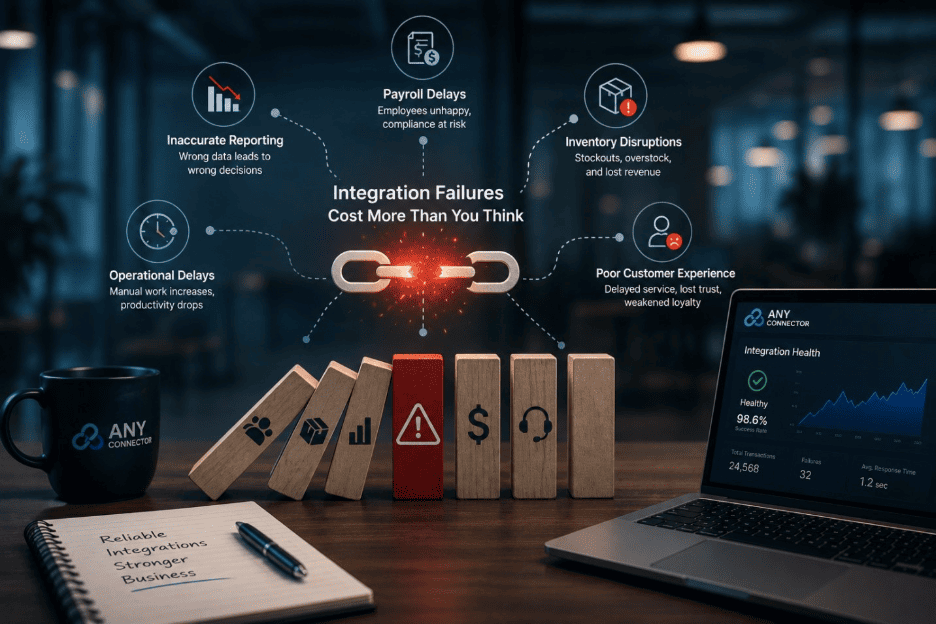
But when integration fails, the impact is rarely limited to one technical error. A missed sync can delay payroll, distort stock levels, break automated workflows, or leave customer-facing teams without the latest information. In a connected enterprise, every integration supports a business process. When that process breaks, the business feels it quickly.
But when integration fails, the impact is rarely limited to one technical error. A missed sync can delay payroll, distort stock levels, break automated workflows, or leave customer-facing teams without the latest information. In a connected enterprise, every integration supports a business process. When that process breaks, the business feels it quickly.
Why Integration Failures Become Business Failures
Integration failures often begin quietly. One API response changes, one required field goes missing, one authentication token expires, or one scheduled job does not complete. At first, the issue may look small. Yet the downstream effect can reach HR, finance, operations, customer service, and leadership reporting before anyone realizes the original connection has failed.
Consider a restaurant enterprise where employee records fail to move cleanly from HR into payroll. What starts as a data movement issue can become a payroll delay, a manager escalation, a finance reconciliation problem, and an employee experience concern. The same pattern appears in inventory. If POS transactions do not update stock levels accurately, purchasing decisions are made with outdated information, creating overstock, shortages, or avoidable waste.
Business intelligence is equally exposed. Dashboards depend on reliable data flowing from finance, operations, HR, customer engagement, and sales systems. When even one integration stops working, KPIs lose credibility and leaders spend time questioning the data instead of acting on it.
This is why integration visibility matters. As AnyConnector explains in Why Integration Visibility Is Becoming the Backbone of Modern IT Operations, connected systems only create value when teams can see what is happening inside the workflows that keep them running.
Consider a restaurant enterprise where employee records fail to move cleanly from HR into payroll. What starts as a data movement issue can become a payroll delay, a manager escalation, a finance reconciliation problem, and an employee experience concern. The same pattern appears in inventory. If POS transactions do not update stock levels accurately, purchasing decisions are made with outdated information, creating overstock, shortages, or avoidable waste.
Business intelligence is equally exposed. Dashboards depend on reliable data flowing from finance, operations, HR, customer engagement, and sales systems. When even one integration stops working, KPIs lose credibility and leaders spend time questioning the data instead of acting on it.
This is why integration visibility matters. As AnyConnector explains in Why Integration Visibility Is Becoming the Backbone of Modern IT Operations, connected systems only create value when teams can see what is happening inside the workflows that keep them running.
Why Enterprise Integrations Break
Most integration failures are not caused by bad technology. They happen because business systems are constantly changing. Vendors release new API versions, deprecate endpoints, revise authentication requirements, adjust data structures, or update response formats. If teams are not monitoring these changes closely, they often discover the problem only after a business process has already been disrupted.
Growth adds another layer of risk. Every new application creates another connection to maintain, another dependency to track, and another possible point of failure. What begins as a simple point-to-point connection can grow into a fragile network of custom logic that is difficult to monitor, scale, or change.
Data quality issues also interrupt automation. Missing employee IDs, invalid product codes, duplicate customer records, inconsistent field formats, and incomplete transactions can all prevent workflows from completing successfully. Even a strong integration platform cannot deliver reliable outcomes if poor-quality data enters the process unchecked.
Network interruptions and temporary outages create similar challenges. A short disruption might not seem serious, but without intelligent retry logic and alerting, temporary failures can become long-running operational issues.
Growth adds another layer of risk. Every new application creates another connection to maintain, another dependency to track, and another possible point of failure. What begins as a simple point-to-point connection can grow into a fragile network of custom logic that is difficult to monitor, scale, or change.
Data quality issues also interrupt automation. Missing employee IDs, invalid product codes, duplicate customer records, inconsistent field formats, and incomplete transactions can all prevent workflows from completing successfully. Even a strong integration platform cannot deliver reliable outcomes if poor-quality data enters the process unchecked.
Network interruptions and temporary outages create similar challenges. A short disruption might not seem serious, but without intelligent retry logic and alerting, temporary failures can become long-running operational issues.
How to Prevent Integration Failures Before They Spread
The goal is not to pretend failures will never happen. In distributed systems, temporary failures are inevitable. The real goal is to build integrations that detect issues early, recover intelligently, and reduce business disruption.
That starts with continuous monitoring. IT and operations teams need visibility into transaction status, processing delays, failed requests, API performance, and system health. Instead of waiting for employees or customers to report missing data, teams should be able to identify and resolve issues before they affect the business.
Retry mechanisms are equally important. If an API is temporarily unavailable or a network interruption occurs, the integration should not require manual intervention every time. Intelligent retry logic helps failed transactions complete automatically after the right interval, improving reliability without adding operational burden.
Timing also matters. Not every workflow needs real-time movement, and not every process should wait for a nightly batch. The strongest integration strategies match timing to business need. For example, customer-facing updates may require event-driven speed, while payroll, accounting, or reporting workflows may benefit from scheduled delivery that prioritizes completeness and control. AnyConnector explores this balance in Right-Time Integrations - Event-Driven vs. Scheduled (and When Each Wins).
That starts with continuous monitoring. IT and operations teams need visibility into transaction status, processing delays, failed requests, API performance, and system health. Instead of waiting for employees or customers to report missing data, teams should be able to identify and resolve issues before they affect the business.
Retry mechanisms are equally important. If an API is temporarily unavailable or a network interruption occurs, the integration should not require manual intervention every time. Intelligent retry logic helps failed transactions complete automatically after the right interval, improving reliability without adding operational burden.
Timing also matters. Not every workflow needs real-time movement, and not every process should wait for a nightly batch. The strongest integration strategies match timing to business need. For example, customer-facing updates may require event-driven speed, while payroll, accounting, or reporting workflows may benefit from scheduled delivery that prioritizes completeness and control. AnyConnector explores this balance in Right-Time Integrations - Event-Driven vs. Scheduled (and When Each Wins).
Reliability Does Not End at Go-Live
Many organizations treat an integration project as complete once it reaches production. In reality, go-live is only the beginning. Business requirements evolve, vendors update their platforms, data models change, and new applications enter the technology stack. Integrations need ongoing monitoring, governance, optimization, and lifecycle management to remain dependable.
This is where a platform-led approach becomes valuable. Centralizing integrations gives teams a clearer way to manage connectivity, reuse patterns, standardize rules, monitor performance, and respond to change without rebuilding the same logic again and again. It also reduces the pressure on IT teams by giving the business a more scalable foundation for future workflows. For more on that shift, see How Integration Platforms Remove IT Bottlenecks and Speed Up Delivery.
This is where a platform-led approach becomes valuable. Centralizing integrations gives teams a clearer way to manage connectivity, reuse patterns, standardize rules, monitor performance, and respond to change without rebuilding the same logic again and again. It also reduces the pressure on IT teams by giving the business a more scalable foundation for future workflows. For more on that shift, see How Integration Platforms Remove IT Bottlenecks and Speed Up Delivery.
Streamline Your Inventory. Order Smartly.
Start Simplifying Your Orders with Any Connector
Final Takeaway
Every integration supports a business outcome. When integrations fail, the impact can reach payroll, inventory, reporting, operations, customer experience, and executive decision-making. The cost is not only technical downtime; it is delayed work, manual fixes, lost trust, and slower execution.
Preventing those failures requires more than connecting systems once. It requires visibility, validation, intelligent recovery, right-time delivery, and centralized governance. Organizations that invest in integration reliability create a stronger operating foundation - one that keeps critical systems aligned today and makes future growth easier to support.
Ready to make integration reliability a business advantage? Any Connector helps enterprises build scalable, visible, and resilient integration workflows that keep critical systems connected and operations moving with confidence.
Preventing those failures requires more than connecting systems once. It requires visibility, validation, intelligent recovery, right-time delivery, and centralized governance. Organizations that invest in integration reliability create a stronger operating foundation - one that keeps critical systems aligned today and makes future growth easier to support.
Ready to make integration reliability a business advantage? Any Connector helps enterprises build scalable, visible, and resilient integration workflows that keep critical systems connected and operations moving with confidence.
Recommended
integrations