Introduction
Most leaders already understand the value of integration. When ERP, HRIS, payroll, inventory, and analytics systems can exchange data, work moves faster and teams spend less time patching together spreadsheets. That is still important. But integration by itself is no longer the finish line.
The real opportunity starts after the connection is made. Once systems can talk, the next question is bigger and more strategic - what should happen next, in what order, and under which conditions? That is where business orchestration enters the picture.
It helps to think of integration as the plumbing and orchestration as the operating logic. One moves data from place to place. The other decides how the business should respond when that data changes. Leaders who treat those two things as the same often end up with a tech stack that looks connected on paper but still feels manual in practice.
The real opportunity starts after the connection is made. Once systems can talk, the next question is bigger and more strategic - what should happen next, in what order, and under which conditions? That is where business orchestration enters the picture.
It helps to think of integration as the plumbing and orchestration as the operating logic. One moves data from place to place. The other decides how the business should respond when that data changes. Leaders who treat those two things as the same often end up with a tech stack that looks connected on paper but still feels manual in practice.
Integration is now the baseline not the differentiator
A few years ago, simply connecting two important systems felt like progress because it was. If an ecommerce platform could pass orders into an ERP, or if workforce data could move from HR into payroll without repeated manual entry, that solved a real operational headache.
But the bar has moved. Connected systems are now a baseline expectation in modern operations, not a durable competitive advantage. Businesses can have dozens of integrations running successfully and still struggle with delayed approvals, missing handoffs, inconsistent reporting, and teams that have to intervene every time something changes.
That is the core gap integration answers whether systems can share data, while orchestration defines what should happen because that data was shared.
But the bar has moved. Connected systems are now a baseline expectation in modern operations, not a durable competitive advantage. Businesses can have dozens of integrations running successfully and still struggle with delayed approvals, missing handoffs, inconsistent reporting, and teams that have to intervene every time something changes.
That is the core gap integration answers whether systems can share data, while orchestration defines what should happen because that data was shared.
What business orchestration actually looks like
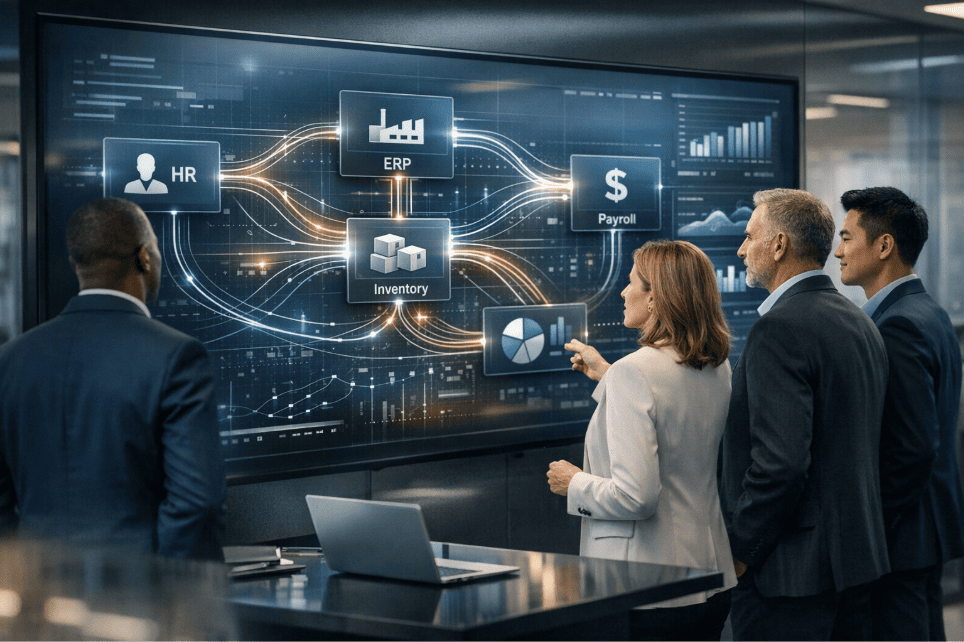
Business orchestration sits above the integration layer. It defines the timing, the workflow logic, the conditions, and the sequence of actions across systems. In other words, it turns a collection of connected tools into an operating model.
Consider a new employee record entering the HRIS. In an orchestrated environment, that single event can trigger onboarding tasks, provision access in the right systems, notify managers, create payroll records, and launch a welcome sequence automatically. No one has to remember the next step because the workflow already knows what comes next.
That is a very different outcome from a simple sync. Data is not just moving. The business is responding.
Consider a new employee record entering the HRIS. In an orchestrated environment, that single event can trigger onboarding tasks, provision access in the right systems, notify managers, create payroll records, and launch a welcome sequence automatically. No one has to remember the next step because the workflow already knows what comes next.
That is a very different outcome from a simple sync. Data is not just moving. The business is responding.
Why so many companies stop at integration
Many organizations stall at the integration layer because they solve operational problems one tool at a time. A process breaks, so a new application is added or a direct connection is built. Then another exception appears, and another patch follows. Over time, the stack grows more connected but also more fragile.
That is exactly why a platform-led approach matters. Any Connector’s post From Point-to-Point to Platform-Led Integrations makes the case for replacing fragile one-off links with a more scalable integration foundation.
Another reason is that workflow design is harder than data sync. Mapping fields between systems is usually straightforward. Defining the full chain of triggers, approvals, exceptions, ownership, and timing requires cross-functional thinking, and many teams do not do that work early enough.
And without a unified integration layer, each connection becomes its own isolated project. The result is scattered logic, limited visibility, and changes that are harder to make than they should be.
That is exactly why a platform-led approach matters. Any Connector’s post From Point-to-Point to Platform-Led Integrations makes the case for replacing fragile one-off links with a more scalable integration foundation.
Another reason is that workflow design is harder than data sync. Mapping fields between systems is usually straightforward. Defining the full chain of triggers, approvals, exceptions, ownership, and timing requires cross-functional thinking, and many teams do not do that work early enough.
And without a unified integration layer, each connection becomes its own isolated project. The result is scattered logic, limited visibility, and changes that are harder to make than they should be.
The hidden cost of staying in integration mode
Operations without orchestration rarely look broken from the outside. In fact, that is what makes the problem easy to underestimate. Orders flow, employees get paid, reports are eventually delivered, and managers find ways to keep things moving.
But under the surface, teams are doing manual handoffs that should be automated. Approval chains live in inboxes. Someone still has to notice that data arrived in one system and then take action in another. Reporting slows down because people are reconciling information from multiple sources before they trust it.
None of those workarounds seem dramatic on their own, yet together they create a steady tax on speed, accuracy, and scale. They also make it much harder for leaders to see how work actually flows through the business.
But under the surface, teams are doing manual handoffs that should be automated. Approval chains live in inboxes. Someone still has to notice that data arrived in one system and then take action in another. Reporting slows down because people are reconciling information from multiple sources before they trust it.
None of those workarounds seem dramatic on their own, yet together they create a steady tax on speed, accuracy, and scale. They also make it much harder for leaders to see how work actually flows through the business.
Where orchestration changes the game
The biggest shift is that automation becomes contextual rather than mechanical. Instead of automating one isolated task, orchestration automates a sequence of decisions. Systems can react to conditions, route work differently based on exceptions, and keep downstream teams aligned without waiting for manual intervention.
Decision-making gets faster as well. When the workflow is explicit and the data is already where it should be, teams spend less time chasing updates and more time acting on them.
Operations also scale more cleanly. Point-to-point connections tend to become messy as volume, systems, and business rules increase. Orchestrated workflows are easier to evolve because the logic is centralized rather than hidden across one-off connections.
This is the same broader shift described in The Future of Enterprise Integrations 2026 and Beyond, where the direction of enterprise integration is moving from basic connectivity toward coordinated, intelligent operations.
Decision-making gets faster as well. When the workflow is explicit and the data is already where it should be, teams spend less time chasing updates and more time acting on them.
Operations also scale more cleanly. Point-to-point connections tend to become messy as volume, systems, and business rules increase. Orchestrated workflows are easier to evolve because the logic is centralized rather than hidden across one-off connections.
This is the same broader shift described in The Future of Enterprise Integrations 2026 and Beyond, where the direction of enterprise integration is moving from basic connectivity toward coordinated, intelligent operations.
Timing matters more than most teams realize
A major part of orchestration is deciding when actions should happen. Not every workflow needs to fire instantly, and not every process should wait for a scheduled batch. Good orchestration depends on matching timing to business need.
Some moments benefit from immediate response, such as an order confirmation, an employee status change, or an inventory adjustment after a sale. Other workflows are better handled on a schedule, especially when they depend on complete data sets or controlled processing windows.
That balance is why Right-Time Integrations - Event-Driven vs Scheduled (and When Each Wins) fits naturally into this conversation. The strongest orchestration models do not force every integration into one timing pattern. They use event-driven and scheduled workflows together, based on what the process actually requires.
Some moments benefit from immediate response, such as an order confirmation, an employee status change, or an inventory adjustment after a sale. Other workflows are better handled on a schedule, especially when they depend on complete data sets or controlled processing windows.
That balance is why Right-Time Integrations - Event-Driven vs Scheduled (and When Each Wins) fits naturally into this conversation. The strongest orchestration models do not force every integration into one timing pattern. They use event-driven and scheduled workflows together, based on what the process actually requires.
How leaders can move from integration to orchestration
The first step is to map workflows before automating them. Many teams jump straight into implementation without fully defining the process, the trigger points, the exception paths, and the people who need to stay informed.
The second step is to centralize the integration layer so logic can be managed across systems instead of inside disconnected interfaces. That makes change easier and creates a clearer operating view of how the business works.
The third step is to think in terms of outcomes, not just data movement. The goal is rarely to sync a field for its own sake. The goal is to make sure that when something important happens in one system, the right sequence of actions unfolds everywhere else it matters.
And finally, build for change. Systems will be replaced. Rules will evolve. New workflows will emerge. Good orchestration is not rigid; it gives the business a way to adapt without rebuilding everything from scratch.
The second step is to centralize the integration layer so logic can be managed across systems instead of inside disconnected interfaces. That makes change easier and creates a clearer operating view of how the business works.
The third step is to think in terms of outcomes, not just data movement. The goal is rarely to sync a field for its own sake. The goal is to make sure that when something important happens in one system, the right sequence of actions unfolds everywhere else it matters.
And finally, build for change. Systems will be replaced. Rules will evolve. New workflows will emerge. Good orchestration is not rigid; it gives the business a way to adapt without rebuilding everything from scratch.
Streamline Your Inventory. Order Smartly.
Start Simplifying Your Orders with Any Connector
A better way to think about the tech stack
Leaders often think of the tech stack as a list of tools. Orchestration asks them to see it as a coordinated system. That shift sounds subtle, but it changes the questions a business starts asking.
Instead of asking what new tool should be added next, teams begin asking how systems should respond to the events that matter most in the business. That usually leads to better automation decisions, better visibility, and better long-term investments.
Integration is still essential. It is just not the whole story anymore. If systems are connected but operations still feel fragmented, slow, or overly dependent on manual effort, the missing layer is probably orchestration.
Instead of asking what new tool should be added next, teams begin asking how systems should respond to the events that matter most in the business. That usually leads to better automation decisions, better visibility, and better long-term investments.
Integration is still essential. It is just not the whole story anymore. If systems are connected but operations still feel fragmented, slow, or overly dependent on manual effort, the missing layer is probably orchestration.
Ready to go beyond integration?
If your systems are connected but your operations still depend on handoffs, workarounds, and manual follow-through, that gap is worth closing. A stronger integration foundation can do more than sync data. It can create structured, automated workflows across the entire tech stack.
Recommended
business-orchestration