Introduction
Businesses today do not operate in still water. New applications are introduced constantly, customer expectations keep rising, and operational processes become more complex with every new channel, system, and workflow.
For a while, direct integration can seem like the fastest answer. One system needs to talk to another, so a connection is built. Then another tool is added, another workflow changes, and another connection is created. Over time, what started as a practical fix can turn into a tightly coupled web of dependencies that is difficult to scale, maintain, or change.
API-led connectivity offers a better path. Instead of building rigid, one-off links between applications, organizations expose data and processes through reusable APIs. Those APIs become flexible building blocks that can support multiple systems, teams, and business needs without forcing IT to rebuild the same integration logic again and again.
In a market where speed and adaptability matter, integration strategy is no longer a back-office technical decision. It is a foundation for operational agility, digital transformation, and long-term growth.
“The goal is no longer just to connect systems. The goal is to create an integration layer that can adapt as the business changes.”
For a while, direct integration can seem like the fastest answer. One system needs to talk to another, so a connection is built. Then another tool is added, another workflow changes, and another connection is created. Over time, what started as a practical fix can turn into a tightly coupled web of dependencies that is difficult to scale, maintain, or change.
API-led connectivity offers a better path. Instead of building rigid, one-off links between applications, organizations expose data and processes through reusable APIs. Those APIs become flexible building blocks that can support multiple systems, teams, and business needs without forcing IT to rebuild the same integration logic again and again.
In a market where speed and adaptability matter, integration strategy is no longer a back-office technical decision. It is a foundation for operational agility, digital transformation, and long-term growth.
“The goal is no longer just to connect systems. The goal is to create an integration layer that can adapt as the business changes.”
Why Traditional Integrations No Longer Work
Traditional point-to-point integrations were built to solve specific problems. They connected one application to another, often around a single workflow or departmental need. That approach worked when technology stacks were smaller and business processes changed slowly.
Today, the same approach creates friction. A new ERP update, an added payroll tool, a revised approval workflow, or a new reporting requirement can trigger redevelopment across several connected systems. The more custom links an organization adds, the harder it becomes to understand which connection owns which logic, where data should be transformed, and what might break when one system changes.
This is also why many organizations are moving beyond basic connectivity toward business orchestration. As Any Connector explains in From System Integration to Business Orchestration, the bigger opportunity begins after systems can exchange data - leaders also need workflows that know what should happen next, in the right sequence, and under the right conditions.
Today, the same approach creates friction. A new ERP update, an added payroll tool, a revised approval workflow, or a new reporting requirement can trigger redevelopment across several connected systems. The more custom links an organization adds, the harder it becomes to understand which connection owns which logic, where data should be transformed, and what might break when one system changes.
This is also why many organizations are moving beyond basic connectivity toward business orchestration. As Any Connector explains in From System Integration to Business Orchestration, the bigger opportunity begins after systems can exchange data - leaders also need workflows that know what should happen next, in the right sequence, and under the right conditions.
What API-Led Connectivity Really Means
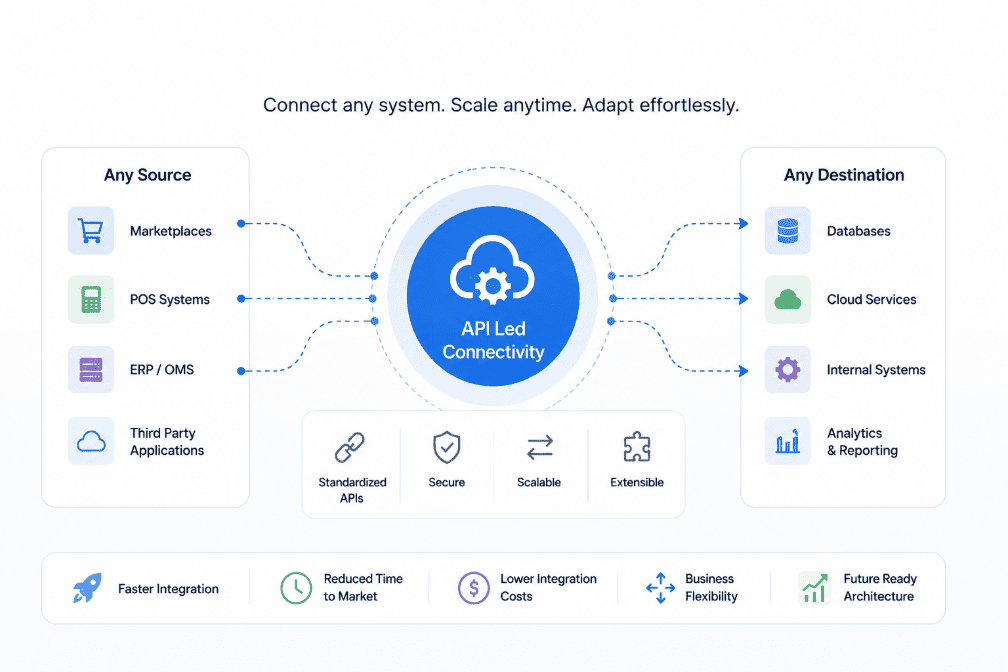
API-led connectivity is an integration approach that exposes systems, data, and business capabilities through reusable APIs rather than direct custom-coded links. Instead of creating a separate integration for every application pair, APIs act as standardized access points that can be reused across multiple workflows.
A practical API-led model often separates integration into layers. System APIs unlock access to core platforms such as ERP, HR, payroll, CRM, POS, or eCommerce systems. Process APIs combine and shape information around business workflows. Experience APIs delivers the right data to the right users, applications, or digital touchpoints.
This layered structure matters because it separates change. A front-end application can evolve without forcing a full rebuild of the system connection underneath it. A business workflow can be adjusted without breaking every consumer of the data. Over time, the organization gains a cleaner, more modular integration foundation.
Flexibility Is the New Competitive Advantage
Modern businesses need to respond quickly. A new digital service may need to be launched in weeks. A new partner may need secure data access. A newly acquired location may need to connect to corporate systems without months of custom work.
Rigid integrations slow that momentum because every new requirement becomes another development project. API-led connectivity changes the pattern. Once reusable APIs are available, teams can plug new workflows into existing capabilities instead of rebuilding from scratch.
The impact is felt beyond IT. Operations teams spend less time waiting for manual exports. Finance teams receive more consistent data. HR and payroll workflows can move with fewer handoffs. Customer-facing teams can rely on systems that reflect the same information at the same time.
Rigid integrations slow that momentum because every new requirement becomes another development project. API-led connectivity changes the pattern. Once reusable APIs are available, teams can plug new workflows into existing capabilities instead of rebuilding from scratch.
The impact is felt beyond IT. Operations teams spend less time waiting for manual exports. Finance teams receive more consistent data. HR and payroll workflows can move with fewer handoffs. Customer-facing teams can rely on systems that reflect the same information at the same time.
How API-Led Connectivity Supports Scalable Growth
Growth usually brings more systems, more processes, more teams, and more exceptions. Without a scalable integration framework, complexity grows faster than the business can manage it.
API-led connectivity supports scalability by creating a modular integration environment. New applications can be added without disturbing existing workflows. Existing APIs can serve multiple departments. Data movement becomes easier to govern because teams are not managing dozens of isolated custom connections with different rules and monitoring practices.
That platform-led approach also helps reduce delivery bottlenecks. Any Connector explores this in How Integration Platforms Remove IT Bottlenecks and Speed Up Delivery, where the focus is on helping teams move faster while still preserving governance, visibility, and control.
API-led connectivity supports scalability by creating a modular integration environment. New applications can be added without disturbing existing workflows. Existing APIs can serve multiple departments. Data movement becomes easier to govern because teams are not managing dozens of isolated custom connections with different rules and monitoring practices.
That platform-led approach also helps reduce delivery bottlenecks. Any Connector explores this in How Integration Platforms Remove IT Bottlenecks and Speed Up Delivery, where the focus is on helping teams move faster while still preserving governance, visibility, and control.
Streamline Your Inventory. Order Smartly.
Start Simplifying Your Orders with Any Connector
API-Led Connectivity and Digital Transformation
Digital transformation is not simply about adopting more software. It is about making applications, data, and workflows operate together in a way that improves how the business runs.
API-led connectivity makes that possible without requiring organizations to replace everything at once. Legacy systems can continue to serve important business functions while APIs make their data available to cloud applications, analytics tools, automation workflows, and modern digital experiences.
This incremental path reduces risk. Businesses can modernize at the edges, connect critical workflows first, and expand over time. As automation, AI, and cloud-native platforms become more central to operations; reusable APIs give organizations the flexibility to adopt new technologies without starting every integration from zero.
Why Integration Platforms Matter
As integration needs to expand, many businesses realize that API-led connectivity is easier to manage through a modern integration platform. A platform gives teams a central place to build, monitor, secure, and govern APIs and workflows.
Instead of treating every integration as a separate project, organizations can standardize how systems connect. Reusable connectors, shared mappings, centralized monitoring, and consistent security policies help reduce complexity while improving reliability.
This is where integration becomes more than an IT task. A strong integration platform gives the business a faster way to launch initiatives, improve visibility, reduce manual work, and support growth without multiplying operational risk.
Instead of treating every integration as a separate project, organizations can standardize how systems connect. Reusable connectors, shared mappings, centralized monitoring, and consistent security policies help reduce complexity while improving reliability.
This is where integration becomes more than an IT task. A strong integration platform gives the business a faster way to launch initiatives, improve visibility, reduce manual work, and support growth without multiplying operational risk.
Building a Future-Ready Integration Strategy
The future of enterprise technology will belong to organizations that can adapt quickly. Businesses that continue to rely on rigid integrations may find themselves slowed by the very systems that were meant to help them grow.
API-led connectivity creates a more future-ready model. It gives organizations reusable building blocks, cleaner architecture, and a scalable way to connect systems across departments, locations, and digital channels.
For leaders, the message is clear- integration strategy should not be treated as technical maintenance. It should be treated as a growth enabler. The more flexible the integration foundation, the faster the business can respond to new opportunities, new tools, and new customer expectations.
Ready to move from rigid integrations to flexible systems?
Any Connector helps businesses simplify integration through scalable API-led architectures that support automation, orchestration, and seamless system connectivity.
API-led connectivity creates a more future-ready model. It gives organizations reusable building blocks, cleaner architecture, and a scalable way to connect systems across departments, locations, and digital channels.
For leaders, the message is clear- integration strategy should not be treated as technical maintenance. It should be treated as a growth enabler. The more flexible the integration foundation, the faster the business can respond to new opportunities, new tools, and new customer expectations.
Ready to move from rigid integrations to flexible systems?
Any Connector helps businesses simplify integration through scalable API-led architectures that support automation, orchestration, and seamless system connectivity.
Recommended
api-integration