Introduction
A practical guide for building connected systems, cleaner data flows, and faster business outcomes from day one.
Digital transformation is often described in terms of new applications, cloud platforms, automation tools, analytics dashboards, and AI initiatives. Those investments matter, but they do not create transformation on their own. The real value appears when people, processes, and systems begin working together as one connected operating model.
That is where many transformation roadmaps fall short. Organizations may spend months selecting software and redesigning workflows, only to treat integration as a technical task that can be solved later. By the time applications go live, teams discover that data does not move cleanly, approvals still depend on manual handoffs, and reporting requires reconciliation across disconnected systems.
The lesson is simple - digital transformation should not begin with isolated technology decisions. It should begin with a plan for how every system, workflow, and data source will connect.
Digital transformation is often described in terms of new applications, cloud platforms, automation tools, analytics dashboards, and AI initiatives. Those investments matter, but they do not create transformation on their own. The real value appears when people, processes, and systems begin working together as one connected operating model.
That is where many transformation roadmaps fall short. Organizations may spend months selecting software and redesigning workflows, only to treat integration as a technical task that can be solved later. By the time applications go live, teams discover that data does not move cleanly, approvals still depend on manual handoffs, and reporting requires reconciliation across disconnected systems.
The lesson is simple - digital transformation should not begin with isolated technology decisions. It should begin with a plan for how every system, workflow, and data source will connect.
Transformation Depends on Flow, Not Just Software
Most businesses are not short on tools. Sales, finance, HR, operations, support, and analytics teams each have platforms designed to improve their specific part of the business. The problem starts when those platforms become islands. A modern HR system delivers limited value if employee records still need to be copied into payroll. A strong analytics platform cannot guide decisions if the source data is scattered, delayed, or inconsistent. Automation also breaks down when the systems behind it do not share reliable information at the right moment.
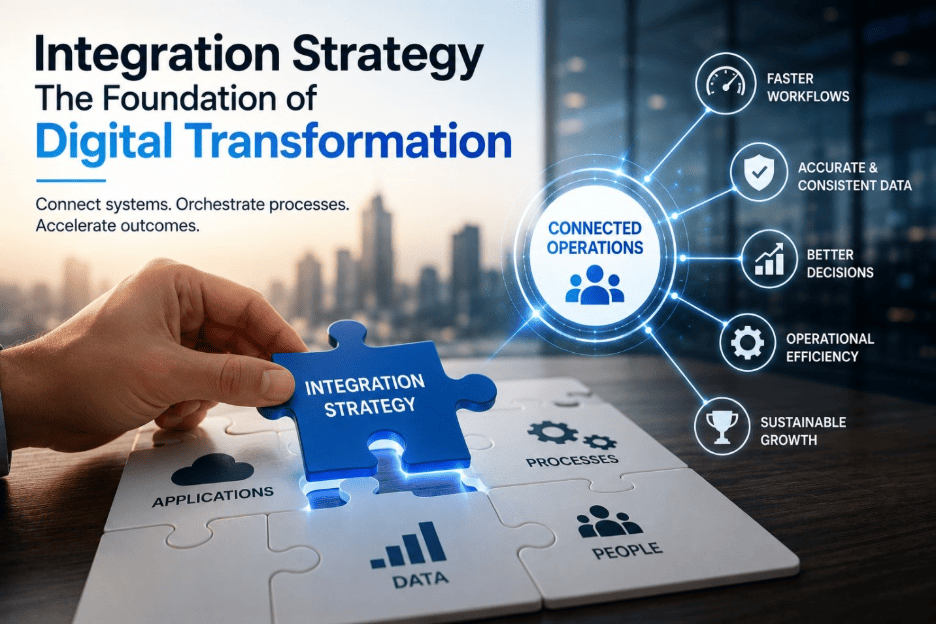
An integration strategy turns individual technology investments into a connected business environment. It defines how applications exchange information, how workflows move across departments, how exceptions are monitored, and how new systems can be added without creating another layer of complexity.
This is also why integration-first thinking is becoming a competitive advantage. As explored in The Competitive Advantage of Integration-First Businesses, connected systems help businesses move faster because teams are no longer waiting on manual updates, exports, or duplicated work.
An integration strategy turns individual technology investments into a connected business environment. It defines how applications exchange information, how workflows move across departments, how exceptions are monitored, and how new systems can be added without creating another layer of complexity.
This is also why integration-first thinking is becoming a competitive advantage. As explored in The Competitive Advantage of Integration-First Businesses, connected systems help businesses move faster because teams are no longer waiting on manual updates, exports, or duplicated work.
Why Integration Gets Missed Until It Becomes a Problem
Integration is easy to underestimate because it is usually less visible than the software employees use every day. Business leaders naturally focus on features, user adoption, implementation timelines, and expected outcomes. Project teams focus on configuration, training, and launch readiness. The integration layer often becomes something to address once the main systems are in place.
That approach creates avoidable friction. After go-live, teams may discover that customer updates do not reach the right platform, finance reports do not match operational data, or onboarding workflows still require manual follow-up. What was supposed to simplify the business can suddenly add new workarounds.
Planning integration early prevents those gaps. It gives every transformation initiative a clearer operating blueprint - which systems are the source of truth, which workflows should be automated, where approvals happen, how errors are detected, and how data quality is protected across the ecosystem.
That approach creates avoidable friction. After go-live, teams may discover that customer updates do not reach the right platform, finance reports do not match operational data, or onboarding workflows still require manual follow-up. What was supposed to simplify the business can suddenly add new workarounds.
Planning integration early prevents those gaps. It gives every transformation initiative a clearer operating blueprint - which systems are the source of truth, which workflows should be automated, where approvals happen, how errors are detected, and how data quality is protected across the ecosystem.
Connected Systems Are Only the Starting Point
For years, integration was mostly viewed as a way to move data from one application to another. Today, that is no longer enough. Businesses need integrations that support complete workflows, not just isolated data transfers.
Consider employee onboarding. Sending a new employee record from HR to payroll is important, but the business process does not end there. Access permissions may need to be created, scheduling tools updated, compliance tasks assigned, equipment requests triggered, and managers notified. If integration only moves the record, employees still rely on manual coordination to complete the process.
A stronger strategy connects the full journey. It ensures systems do not just share data, but also trigger the right next step. That shift from data movement to workflow orchestration is central to modern integration, and it is discussed further in Why Data Synchronization Alone Is No Longer Enough.
Consider employee onboarding. Sending a new employee record from HR to payroll is important, but the business process does not end there. Access permissions may need to be created, scheduling tools updated, compliance tasks assigned, equipment requests triggered, and managers notified. If integration only moves the record, employees still rely on manual coordination to complete the process.
A stronger strategy connects the full journey. It ensures systems do not just share data, but also trigger the right next step. That shift from data movement to workflow orchestration is central to modern integration, and it is discussed further in Why Data Synchronization Alone Is No Longer Enough.
Visibility Makes Transformation Easier to Manage
As transformation expands, the number of connected systems grows. Every workflow depends on data arriving accurately and on time. When something fails silently, the impact may not appear immediately, but it can show up later as delayed payroll, incorrect reporting, missed customer updates, or operational confusion.
This is why integration visibility belongs in the roadmap from the beginning. Leaders need to understand how integration is performing, where failures occur, which workflows are affected, and what needs attention before a small issue becomes a business problem.
The role of visibility is explored in Why Integration Visibility Is Becoming the Backbone of Modern IT Operations, which highlights how monitoring and observability turn integration from a background technical layer into a strategic operational capability.
This is why integration visibility belongs in the roadmap from the beginning. Leaders need to understand how integration is performing, where failures occur, which workflows are affected, and what needs attention before a small issue becomes a business problem.
The role of visibility is explored in Why Integration Visibility Is Becoming the Backbone of Modern IT Operations, which highlights how monitoring and observability turn integration from a background technical layer into a strategic operational capability.
Streamline Your Inventory. Order Smartly.
Start Simplifying Your Orders with Any Connector
A Better Roadmap Starts with Integration by Design
When integration is designed early, transformation becomes easier to phase, scale, and optimize. Teams can automate workflows as new systems go live instead of waiting for a second project to connect them later. Data can be governed with clearer ownership. Reporting can be built on more consistent information. Future applications can be added without rebuilding the entire technology landscape.
This approach also reduces risk. Instead of creating one-off connections for every new requirement, businesses can build a scalable integration foundation that supports growth. As the organization adopts new tools, enters new markets, or introduces AI-driven capabilities, the technology ecosystem can evolve without becoming harder to manage.
This approach also reduces risk. Instead of creating one-off connections for every new requirement, businesses can build a scalable integration foundation that supports growth. As the organization adopts new tools, enters new markets, or introduces AI-driven capabilities, the technology ecosystem can evolve without becoming harder to manage.
How Any Connector Helps Build a Connected Transformation Foundation
Any Connector helps organizations bring integration into the center of their digital transformation strategy. By connecting existing and modern applications through scalable integrations, workflow orchestration, automation, and operational visibility, businesses can move away from disconnected technology decisions and toward a connected operating model.
The result is a transformation roadmap that is not just easier to implement, but easier to manage over time. Systems work together. Processes move faster. Teams trust the data they use. Leaders gain better visibility into how the business is running.
Digital transformation is not achieved by deploying more software. It is achieved when technology creates better flow across the business. With integration strategy built into the roadmap from the start, organizations can turn ambitious transformation goals into measurable, lasting business value.
The result is a transformation roadmap that is not just easier to implement, but easier to manage over time. Systems work together. Processes move faster. Teams trust the data they use. Leaders gain better visibility into how the business is running.
Digital transformation is not achieved by deploying more software. It is achieved when technology creates better flow across the business. With integration strategy built into the roadmap from the start, organizations can turn ambitious transformation goals into measurable, lasting business value.
Recommended
digital-transformation
digital-transformation