Introduction
Enterprise software has never been more powerful or more fragmented. Most organizations now rely on a growing mix of ERP platforms, HR systems, payroll tools, analytics environments, customer applications, and industry-specific software to keep operations moving. The problem is that the value of each system only goes so far on its own. The real advantage shows up when those systems work together as part of one connected operating model.
That is why integration strategy is no longer an IT housekeeping task. It is becoming a business decision with measurable impact on speed, visibility, and scale. In 2026 and beyond, the organizations that connect systems cleanly will be able to respond faster, automate more confidently, and make better decisions with less friction.
In other words, integrations are moving out of the background. They are becoming part of how modern enterprises compete.
That is why integration strategy is no longer an IT housekeeping task. It is becoming a business decision with measurable impact on speed, visibility, and scale. In 2026 and beyond, the organizations that connect systems cleanly will be able to respond faster, automate more confidently, and make better decisions with less friction.
In other words, integrations are moving out of the background. They are becoming part of how modern enterprises compete.
From connectivity to connected intelligence
For years, many integrations were built just to move data from point A to point B. Files were exported on a schedule, teams uploaded spreadsheets, and APIs were added whenever two systems needed to exchange information. That approach worked well enough when technology stacks were smaller and the cost of delay was manageable.
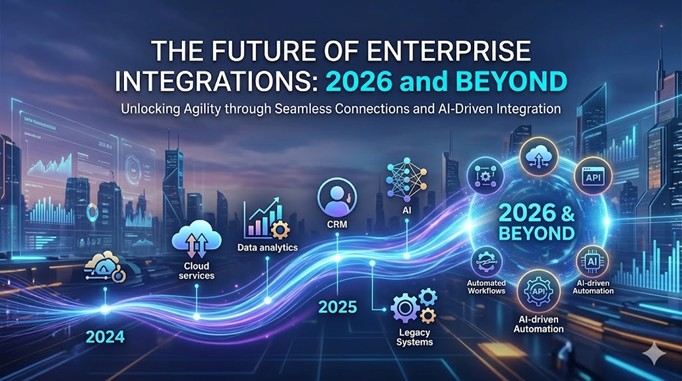
But today’s operations demand more than basic data transfer. Leaders need systems that share information at the right moment, trigger downstream actions automatically, and deliver trustworthy insights without forcing teams to reconcile differences manually. The shift is subtle but important - enterprises are no longer chasing simple connectivity; they are building connected intelligence.
That idea lines up closely with Any Connector’s perspective on platform-led integrations, where the goal is to replace fragile one-off connections with a more scalable integration layer that can support growth without multiplying complexity.
But today’s operations demand more than basic data transfer. Leaders need systems that share information at the right moment, trigger downstream actions automatically, and deliver trustworthy insights without forcing teams to reconcile differences manually. The shift is subtle but important - enterprises are no longer chasing simple connectivity; they are building connected intelligence.
That idea lines up closely with Any Connector’s perspective on platform-led integrations, where the goal is to replace fragile one-off connections with a more scalable integration layer that can support growth without multiplying complexity.
Automation becomes the operating advantage
When integrations are designed well, automation stops feeling like a feature and starts behaving like infrastructure. Sales transactions can update inventory instantly. New hire details can move across HR, payroll, and scheduling without a string of manual handoffs. Financial records can flow into reporting systems without last-minute reconciliation.
This matters because automation does more than save time. It reduces the hidden drag that shows up as delays, exceptions, and workarounds. Instead of spending hours fixing broken data paths, teams can focus on planning, analysis, service, and execution.
A practical example is how workforce data moves across systems. Any Connector’s post on streamlining HR and payroll integrations shows why clean mappings, effective-dated changes, and dependable delivery timing matter so much. When employee data arrives accurately and on time, payroll becomes quieter, managers spend less time chasing exceptions, and operations gain confidence in the data they use every day.
This matters because automation does more than save time. It reduces the hidden drag that shows up as delays, exceptions, and workarounds. Instead of spending hours fixing broken data paths, teams can focus on planning, analysis, service, and execution.
A practical example is how workforce data moves across systems. Any Connector’s post on streamlining HR and payroll integrations shows why clean mappings, effective-dated changes, and dependable delivery timing matter so much. When employee data arrives accurately and on time, payroll becomes quieter, managers spend less time chasing exceptions, and operations gain confidence in the data they use every day.
Speed matters but timing matters even more
There is a common temptation to equate modern integration with real-time everything. In practice, the strongest integration strategies are more thoughtful than that. Some workflows need immediate response because delay creates risk or erodes the customer experience. Others work better on a scheduled cadence that prioritizes completeness, control, and system efficiency.
That is why future-ready enterprises are focusing less on whether every integration is real time and more on whether each workflow is moving at the right time. A menu update, a status notification, or a workforce event may need instant synchronization. A payroll export, financial close process, or overnight reporting job may be better served by a scheduled run.
That balance is captured well in Any Connector’s article on right-time integrations, which frames the real question clearly - not “real time or batch?” but “what timing best supports the business outcome?”
That is why future-ready enterprises are focusing less on whether every integration is real time and more on whether each workflow is moving at the right time. A menu update, a status notification, or a workforce event may need instant synchronization. A payroll export, financial close process, or overnight reporting job may be better served by a scheduled run.
That balance is captured well in Any Connector’s article on right-time integrations, which frames the real question clearly - not “real time or batch?” but “what timing best supports the business outcome?”
Scalability depends on architecture, not effort
As enterprises grow, new systems inevitably enter the stack. New locations, departments, partners, and workflows all introduce fresh integration needs. Without a strong architectural foundation, every additional connection increases maintenance overhead and raises the odds of inconsistent data, brittle logic, and reporting mistrust.
This is where centralized integration architecture becomes a competitive advantage. Instead of creating a new custom path every time another application comes online, organizations can connect through a stable integration layer that standardizes logic, simplifies monitoring, and reduces the risk of ripple effects when change happens.
The difference is significant. Point-to-point integration models often look efficient early on, but they become harder to manage as dependencies multiply. A centralized approach gives enterprises room to expand without constantly rebuilding the roads between systems.
This is where centralized integration architecture becomes a competitive advantage. Instead of creating a new custom path every time another application comes online, organizations can connect through a stable integration layer that standardizes logic, simplifies monitoring, and reduces the risk of ripple effects when change happens.
The difference is significant. Point-to-point integration models often look efficient early on, but they become harder to manage as dependencies multiply. A centralized approach gives enterprises room to expand without constantly rebuilding the roads between systems.
Where Any Connector fits
Any Connector is built for exactly this moment. Instead of asking organizations to manage dozens of isolated system relationships, it gives them a single integration layer for orchestrating data movement across the enterprise. That makes it easier to standardize mappings, support automation, improve monitoring, and keep systems aligned as the business evolves.
Just as importantly, it creates a foundation for better decision-making. When integrations are reliable and data flows consistently, leaders are not waiting on end-of-day exports or patching together spreadsheets to understand performance. They can act on current information with more confidence, because the systems feeding that insight are already synchronized.
That is the bigger story behind enterprise integrations in 2026. This is no longer just about connecting applications. It is about creating a digital ecosystem where operations, data, and decisions move together.
Just as importantly, it creates a foundation for better decision-making. When integrations are reliable and data flows consistently, leaders are not waiting on end-of-day exports or patching together spreadsheets to understand performance. They can act on current information with more confidence, because the systems feeding that insight are already synchronized.
That is the bigger story behind enterprise integrations in 2026. This is no longer just about connecting applications. It is about creating a digital ecosystem where operations, data, and decisions move together.
Bottom line
The future of enterprise integrations will be defined by how intelligently systems communicate, not just whether they connect. Organizations that invest in a scalable integration strategy today will be better positioned to automate faster, respond sooner, and grow with less friction tomorrow.
Ready to turn integration into a competitive advantage?
Connect your enterprise systems through one scalable layer, reduce operational friction, and build the foundation for automation and connected intelligence with Any Connector.
Recommended
enterprise-integrations