The Hidden Risk Behind Every Successful Upgrade
When organizations invest in new software implementations, they typically dedicate significant time and resources to planning, testing, stakeholder alignment, and deployment readiness. Project teams evaluate requirements, map data flows, validate integrations, and carefully manage the go-live process to minimize disruption.
Ironically, many businesses apply far less scrutiny to system upgrades.
Because upgrades are often perceived as incremental improvements rather than major technology initiatives, organizations frequently assume that existing integrations will continue operating without issue. The software vendor may be introducing new features, improving security, modernizing APIs, or enhancing platform performance, but the assumption remains that the change is largely transparent to downstream systems.
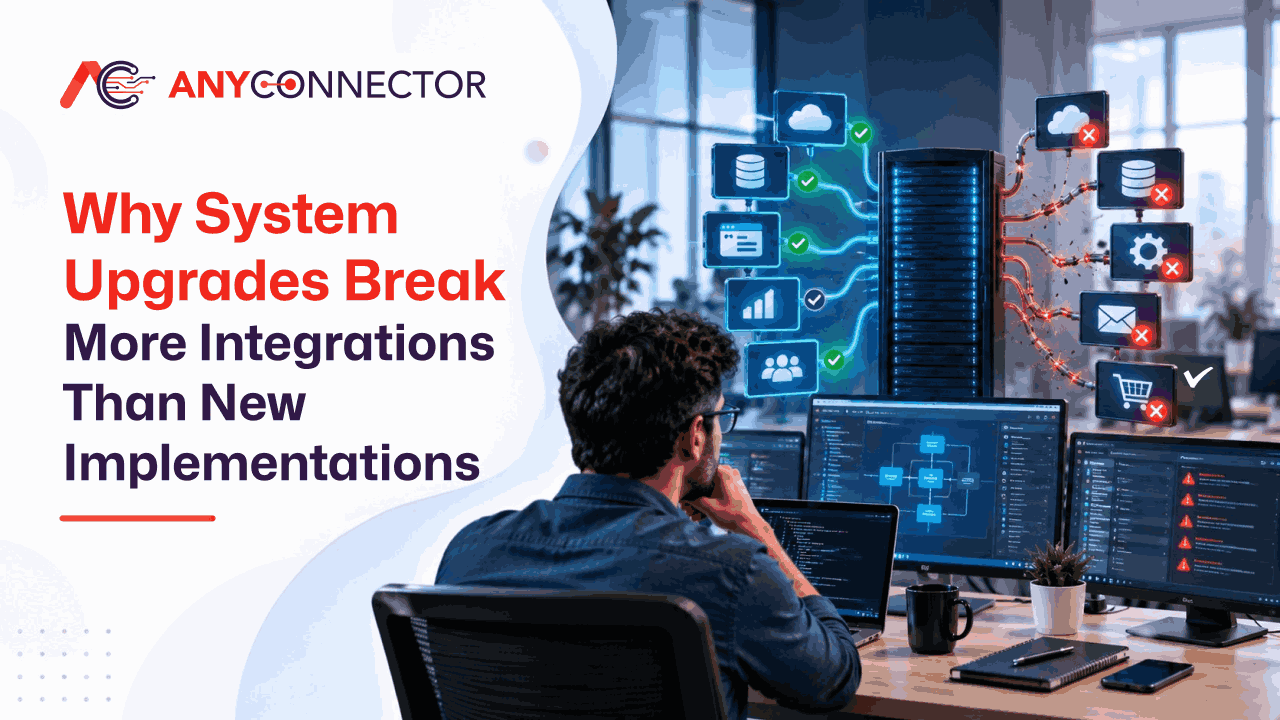
In reality, system upgrades often introduce more integration risk than entirely new implementations.
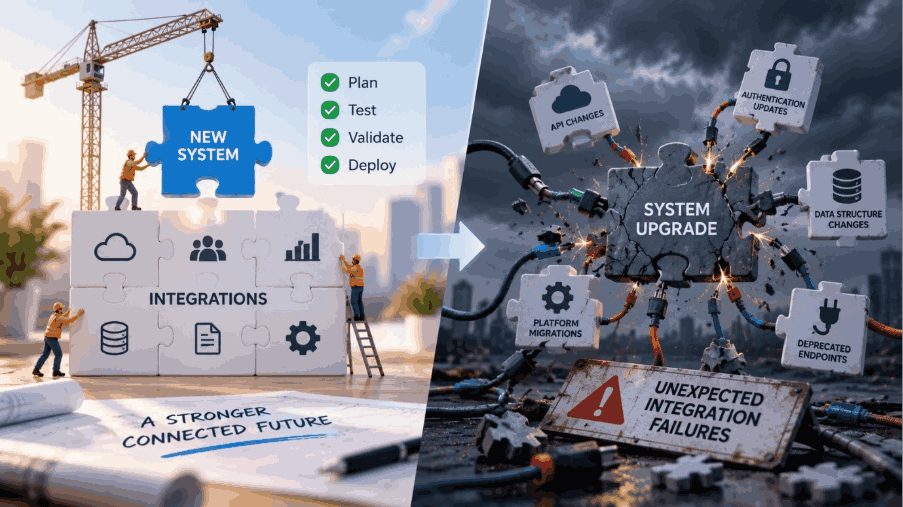
Across enterprise environments, integration failures are commonly triggered not by new applications but by changes to existing ones. API modifications, authentication updates, platform migrations, data structure changes, and vendor-driven enhancements can create unexpected disruptions across interconnected systems. While the upgrade itself may be successful, the integrations supporting critical business processes often become the hidden casualty.
As organizations become increasingly dependent on connected technology ecosystems, understanding and managing upgrade-related integration risk has become essential for maintaining operational continuity.
Ironically, many businesses apply far less scrutiny to system upgrades.
Because upgrades are often perceived as incremental improvements rather than major technology initiatives, organizations frequently assume that existing integrations will continue operating without issue. The software vendor may be introducing new features, improving security, modernizing APIs, or enhancing platform performance, but the assumption remains that the change is largely transparent to downstream systems.
In reality, system upgrades often introduce more integration risk than entirely new implementations.
Across enterprise environments, integration failures are commonly triggered not by new applications but by changes to existing ones. API modifications, authentication updates, platform migrations, data structure changes, and vendor-driven enhancements can create unexpected disruptions across interconnected systems. While the upgrade itself may be successful, the integrations supporting critical business processes often become the hidden casualty.
As organizations become increasingly dependent on connected technology ecosystems, understanding and managing upgrade-related integration risk has become essential for maintaining operational continuity.
Why New Implementations Receive More Attention
New implementations naturally attract executive visibility.
Organizations recognize that introducing a new HR platform, payroll system, ERP solution, inventory application, or point-of-sale platform carries significant business impact. Dedicated project teams are assembled, testing environments are created, and integration requirements are reviewed extensively before deployment.
Every stakeholder understands that changes are coming.
Because expectations are clear, teams proactively evaluate how integrations will be affected. Data mappings are reviewed, interfaces are tested, and potential issues are identified before they reach production environments.
The result is a structured deployment process that prioritizes integration readiness alongside application readiness.
System upgrades rarely receive the same level of attention.
Many upgrades are viewed as routine maintenance activities rather than business-critical events. Since the underlying application remains the same, organizations often assume the integrations connected to it will continue functioning normally.
Unfortunately, that assumption can be costly.
Organizations recognize that introducing a new HR platform, payroll system, ERP solution, inventory application, or point-of-sale platform carries significant business impact. Dedicated project teams are assembled, testing environments are created, and integration requirements are reviewed extensively before deployment.
Every stakeholder understands that changes are coming.
Because expectations are clear, teams proactively evaluate how integrations will be affected. Data mappings are reviewed, interfaces are tested, and potential issues are identified before they reach production environments.
The result is a structured deployment process that prioritizes integration readiness alongside application readiness.
System upgrades rarely receive the same level of attention.
Many upgrades are viewed as routine maintenance activities rather than business-critical events. Since the underlying application remains the same, organizations often assume the integrations connected to it will continue functioning normally.
Unfortunately, that assumption can be costly.
Small Changes Can Have Large Consequences
Enterprise integrations depend on consistency.
When an integration is built, it relies on specific APIs, data formats, authentication methods, field structures, endpoints, and business rules. Even relatively small modifications to those elements can affect how systems communicate.
A vendor may rename a field, introduce new validation requirements, retire an API endpoint, modify authentication protocols, or change data structures within a platform upgrade. Individually, these adjustments may appear minor.
From an integration perspective, however, they can be significant.
A single change can prevent transactions from processing successfully, interrupt data synchronization, generate validation errors, or create downstream reporting inaccuracies. In many cases, the upgrade itself functions exactly as intended while connected integrations begin failing silently in the background.
This is one of the reasons why organizations often discover integration issues only after business users begin reporting missing or inaccurate data.
As discussed in "The True Cost of Integration Failures and How to Prevent Them," integration problems rarely remain isolated technical events. They quickly evolve into operational challenges that affect payroll processing, inventory management, reporting accuracy, workforce operations, and business decision-making.
When an integration is built, it relies on specific APIs, data formats, authentication methods, field structures, endpoints, and business rules. Even relatively small modifications to those elements can affect how systems communicate.
A vendor may rename a field, introduce new validation requirements, retire an API endpoint, modify authentication protocols, or change data structures within a platform upgrade. Individually, these adjustments may appear minor.
From an integration perspective, however, they can be significant.
A single change can prevent transactions from processing successfully, interrupt data synchronization, generate validation errors, or create downstream reporting inaccuracies. In many cases, the upgrade itself functions exactly as intended while connected integrations begin failing silently in the background.
This is one of the reasons why organizations often discover integration issues only after business users begin reporting missing or inaccurate data.
As discussed in "The True Cost of Integration Failures and How to Prevent Them," integration problems rarely remain isolated technical events. They quickly evolve into operational challenges that affect payroll processing, inventory management, reporting accuracy, workforce operations, and business decision-making.
API Evolution Creates Ongoing Integration Challenges
Modern software platforms continue evolving at an increasingly rapid pace.
Cloud-based applications frequently release enhancements, security updates, performance improvements, and new functionality. Vendors may introduce entirely new APIs while gradually retiring older versions. Authentication standards may be updated to align with evolving security requirements. Legacy integration methods may be deprecated in favor of more modern approaches.
These changes are often beneficial for the application itself.
The challenge emerges when dependent integrations are not updated accordingly.
An integration that has operated successfully for years can suddenly experience issues when an API version reaches end-of-life or a vendor modifies authentication requirements. Organizations that lack visibility into their integration landscape may not fully understand which business processes depend on those interfaces until disruptions occur.
This is why integration management must extend beyond initial deployment activities.
As explored in "Why Successful Integrations Don't End at Go-Live," long-term integration success depends on ongoing maintenance, monitoring, optimization, and governance. System upgrades are one of the most important reasons why integration management must remain a continuous operational responsibility.
Cloud-based applications frequently release enhancements, security updates, performance improvements, and new functionality. Vendors may introduce entirely new APIs while gradually retiring older versions. Authentication standards may be updated to align with evolving security requirements. Legacy integration methods may be deprecated in favor of more modern approaches.
These changes are often beneficial for the application itself.
The challenge emerges when dependent integrations are not updated accordingly.
An integration that has operated successfully for years can suddenly experience issues when an API version reaches end-of-life or a vendor modifies authentication requirements. Organizations that lack visibility into their integration landscape may not fully understand which business processes depend on those interfaces until disruptions occur.
This is why integration management must extend beyond initial deployment activities.
As explored in "Why Successful Integrations Don't End at Go-Live," long-term integration success depends on ongoing maintenance, monitoring, optimization, and governance. System upgrades are one of the most important reasons why integration management must remain a continuous operational responsibility.
Platform Migrations Introduce Additional Complexity
Beyond routine upgrades, many organizations are also navigating broader platform migrations.
Vendors continue transitioning customers from legacy environments to cloud-native architectures. Businesses consolidate systems following acquisitions. New security frameworks are introduced. Infrastructure modernization initiatives create additional dependencies between applications.
These migrations often affect more than a single system.
A platform migration may impact multiple integrations simultaneously, creating interconnected risks that are difficult to identify without a comprehensive understanding of the technology ecosystem.
The challenge becomes even greater when organizations manage dozens or hundreds of integrations across multiple locations, departments, and business units.
In these environments, a seemingly simple migration can trigger cascading effects throughout the enterprise.
Without proper planning, organizations may find themselves responding to integration issues after they have already disrupted operations.
Vendors continue transitioning customers from legacy environments to cloud-native architectures. Businesses consolidate systems following acquisitions. New security frameworks are introduced. Infrastructure modernization initiatives create additional dependencies between applications.
These migrations often affect more than a single system.
A platform migration may impact multiple integrations simultaneously, creating interconnected risks that are difficult to identify without a comprehensive understanding of the technology ecosystem.
The challenge becomes even greater when organizations manage dozens or hundreds of integrations across multiple locations, departments, and business units.
In these environments, a seemingly simple migration can trigger cascading effects throughout the enterprise.
Without proper planning, organizations may find themselves responding to integration issues after they have already disrupted operations.
Streamline Your Inventory. Order Smartly.
Start Simplifying Your Orders with Any Connector
Visibility Is Essential During Change
One of the biggest challenges associated with upgrades is the lack of visibility into integration dependencies.
Many organizations can identify the systems they use, but fewer can quickly determine which integrations support those systems, how data flows between applications, and what downstream processes may be affected by change.
This visibility gap increases risk.
When organizations do not fully understand integration dependencies, they cannot accurately assess the potential impact of upgrades, migrations, or vendor-driven changes.
This is where integration monitoring becomes particularly valuable.
As discussed in "Integration Monitoring - The Missing Piece of Enterprise Connectivity," real-time visibility into transaction activity, integration health, and system performance enables organizations to detect issues quickly and respond before they affect business operations.
Monitoring does not eliminate upgrade-related risk, but it significantly improves an organization's ability to identify and address issues before they escalate.
Many organizations can identify the systems they use, but fewer can quickly determine which integrations support those systems, how data flows between applications, and what downstream processes may be affected by change.
This visibility gap increases risk.
When organizations do not fully understand integration dependencies, they cannot accurately assess the potential impact of upgrades, migrations, or vendor-driven changes.
This is where integration monitoring becomes particularly valuable.
As discussed in "Integration Monitoring - The Missing Piece of Enterprise Connectivity," real-time visibility into transaction activity, integration health, and system performance enables organizations to detect issues quickly and respond before they affect business operations.
Monitoring does not eliminate upgrade-related risk, but it significantly improves an organization's ability to identify and address issues before they escalate.
Governance Helps Organizations Manage Change
As technology ecosystems expand, managing upgrades becomes increasingly complex.
Organizations must coordinate multiple vendors, applications, business units, and integration workflows. Without consistent standards and oversight, change management can become fragmented and unpredictable.
Effective integration governance provides the structure necessary to manage this complexity.
Standardized documentation helps teams understand integration dependencies. Version management practices improve visibility into changes. Defined ownership ensures accountability. Lifecycle management processes help organizations evaluate the impact of upgrades before implementation.
In "Why Integration Governance Matters More as Your Business Grows," we explored how governance helps organizations maintain control as integration environments become more complex. Upgrade management is one of the clearest examples of governance delivering measurable operational value.
Organizations that establish governance frameworks are typically better positioned to manage vendor-driven change without introducing unnecessary business disruption.
Organizations must coordinate multiple vendors, applications, business units, and integration workflows. Without consistent standards and oversight, change management can become fragmented and unpredictable.
Effective integration governance provides the structure necessary to manage this complexity.
Standardized documentation helps teams understand integration dependencies. Version management practices improve visibility into changes. Defined ownership ensures accountability. Lifecycle management processes help organizations evaluate the impact of upgrades before implementation.
In "Why Integration Governance Matters More as Your Business Grows," we explored how governance helps organizations maintain control as integration environments become more complex. Upgrade management is one of the clearest examples of governance delivering measurable operational value.
Organizations that establish governance frameworks are typically better positioned to manage vendor-driven change without introducing unnecessary business disruption.
Preparing for Upgrades Without Disrupting Operations
The reality is that upgrades are unavoidable.
Technology platforms will continue evolving. Vendors will continue modernizing their applications. Security standards will continue changing. APIs will continue advancing.
The objective is not to avoid upgrades.
The objective is to prepare for them.
Organizations that treat upgrades with the same level of rigor applied to new implementations are significantly more successful at protecting integration reliability. Understanding dependencies, maintaining accurate documentation, monitoring integration performance, and applying governance standards all contribute to a more resilient technology environment.
The organizations that experience the fewest disruptions are not necessarily those with the simplest technology ecosystems. They are the ones that proactively manage change across those ecosystems.
Technology platforms will continue evolving. Vendors will continue modernizing their applications. Security standards will continue changing. APIs will continue advancing.
The objective is not to avoid upgrades.
The objective is to prepare for them.
Organizations that treat upgrades with the same level of rigor applied to new implementations are significantly more successful at protecting integration reliability. Understanding dependencies, maintaining accurate documentation, monitoring integration performance, and applying governance standards all contribute to a more resilient technology environment.
The organizations that experience the fewest disruptions are not necessarily those with the simplest technology ecosystems. They are the ones that proactively manage change across those ecosystems.
Conclusion
New implementations often receive the most attention, but system upgrades frequently introduce greater integration risk.
API changes, authentication updates, platform migrations, and vendor enhancements can affect critical business processes in ways that are not immediately visible. Without proper planning and oversight, even successful upgrades can lead to integration failures that impact operations across the organization.
By combining integration monitoring, governance, lifecycle management, and dependency visibility, organizations can navigate upgrades more confidently while reducing operational risk.
At Any Connector, we help organizations build and manage integration ecosystems that remain resilient through continuous change. Because in today's connected enterprise, the success of a system upgrade is determined not only by the application itself, but by every integration that depends on it.
API changes, authentication updates, platform migrations, and vendor enhancements can affect critical business processes in ways that are not immediately visible. Without proper planning and oversight, even successful upgrades can lead to integration failures that impact operations across the organization.
By combining integration monitoring, governance, lifecycle management, and dependency visibility, organizations can navigate upgrades more confidently while reducing operational risk.
At Any Connector, we help organizations build and manage integration ecosystems that remain resilient through continuous change. Because in today's connected enterprise, the success of a system upgrade is determined not only by the application itself, but by every integration that depends on it.
Recommended
integration-risk