Growth Creates Complexity. Governance Creates Control.
Most integration challenges are not caused by technology limitations. They are caused by growth.
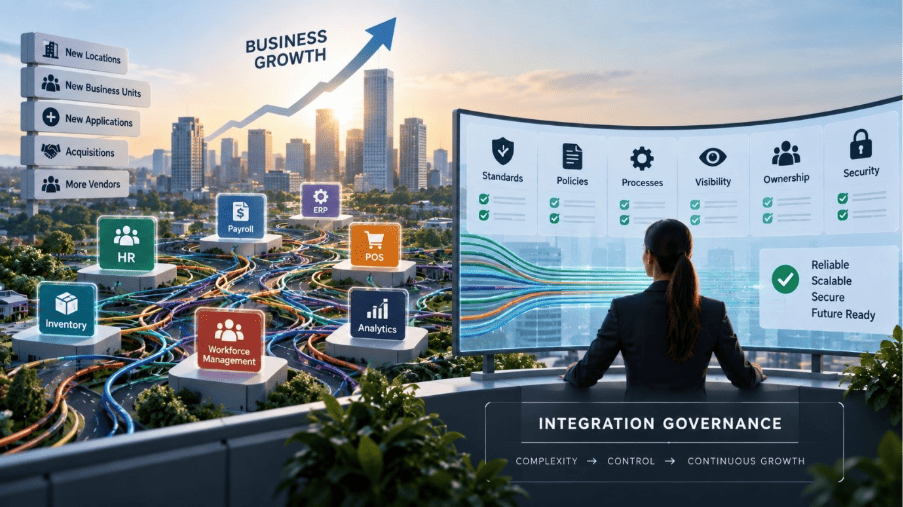
As organizations expand, they add new applications, onboard additional vendors, open new locations, launch new business units, and introduce new operational processes. Every addition increases the number of systems that need to exchange information accurately and reliably. What begins as a manageable set of integrations can quickly evolve into a complex web of dependencies spanning HR, payroll, ERP, point-of-sale, inventory, workforce management, analytics, and other critical business systems.
In the early stages, managing integrations may seem straightforward. Teams can track connections manually, maintain documentation informally, and coordinate changes through direct communication. However, as the business grows, this approach becomes increasingly difficult to sustain.
The challenge is no longer simply connecting systems. The challenge becomes managing those connections at scale.
This is where integration governance becomes essential. Effective governance provides the standards, processes, controls, and visibility needed to keep enterprise integrations reliable, secure, scalable, and maintainable as technology ecosystems continue to expand.
As organizations expand, they add new applications, onboard additional vendors, open new locations, launch new business units, and introduce new operational processes. Every addition increases the number of systems that need to exchange information accurately and reliably. What begins as a manageable set of integrations can quickly evolve into a complex web of dependencies spanning HR, payroll, ERP, point-of-sale, inventory, workforce management, analytics, and other critical business systems.
In the early stages, managing integrations may seem straightforward. Teams can track connections manually, maintain documentation informally, and coordinate changes through direct communication. However, as the business grows, this approach becomes increasingly difficult to sustain.
The challenge is no longer simply connecting systems. The challenge becomes managing those connections at scale.
This is where integration governance becomes essential. Effective governance provides the standards, processes, controls, and visibility needed to keep enterprise integrations reliable, secure, scalable, and maintainable as technology ecosystems continue to expand.
The Hidden Cost of Integration Growth
Business growth often brings technology growth with it.
Organizations invest in specialized applications to improve operations, support new business functions, and gain competitive advantages. New vendors introduce new APIs. Acquisitions bring additional systems into the technology landscape. Departments adopt solutions that address specific operational needs.
While each decision may deliver value independently, the cumulative effect can create significant integration complexity.
Without a governance framework, integrations are often developed by different teams using different standards. Naming conventions vary. Documentation becomes inconsistent. Security requirements differ across systems. API versions are managed differently. Ownership becomes unclear.
Initially, these inconsistencies may appear minor. Over time, however, they create operational challenges that increase support costs, slow project delivery, and introduce unnecessary risk.
As discussed in "From Point-to-Point to Platform-Led Integrations - Why Growing Tech Stacks Need a Better Foundation," integration complexity tends to increase exponentially as organizations add more systems. Without a structured approach, maintaining integration reliability becomes increasingly difficult.
The goal of integration governance is to prevent this complexity from becoming unmanageable.
Organizations invest in specialized applications to improve operations, support new business functions, and gain competitive advantages. New vendors introduce new APIs. Acquisitions bring additional systems into the technology landscape. Departments adopt solutions that address specific operational needs.
While each decision may deliver value independently, the cumulative effect can create significant integration complexity.
Without a governance framework, integrations are often developed by different teams using different standards. Naming conventions vary. Documentation becomes inconsistent. Security requirements differ across systems. API versions are managed differently. Ownership becomes unclear.
Initially, these inconsistencies may appear minor. Over time, however, they create operational challenges that increase support costs, slow project delivery, and introduce unnecessary risk.
As discussed in "From Point-to-Point to Platform-Led Integrations - Why Growing Tech Stacks Need a Better Foundation," integration complexity tends to increase exponentially as organizations add more systems. Without a structured approach, maintaining integration reliability becomes increasingly difficult.
The goal of integration governance is to prevent this complexity from becoming unmanageable.
Governance Creates Consistency Across the Enterprise
One of the primary benefits of integration governance is consistency.
When organizations establish common standards for integration development and management, teams can build, maintain, and troubleshoot integrations more efficiently.
Standardized API design practices create predictable integration patterns. Consistent naming conventions improve clarity across systems and environments. Common documentation requirements ensure critical information remains accessible regardless of who originally implemented an integration.
Consistency reduces confusion and accelerates collaboration.
When new team members join a project, they can quickly understand how integrations are structured. When support teams investigate issues, they can locate relevant information faster. When developers build new integrations, they can follow established standards rather than creating new approaches from scratch.
Governance transforms integrations from isolated technical projects into manageable enterprise assets.
When organizations establish common standards for integration development and management, teams can build, maintain, and troubleshoot integrations more efficiently.
Standardized API design practices create predictable integration patterns. Consistent naming conventions improve clarity across systems and environments. Common documentation requirements ensure critical information remains accessible regardless of who originally implemented an integration.
Consistency reduces confusion and accelerates collaboration.
When new team members join a project, they can quickly understand how integrations are structured. When support teams investigate issues, they can locate relevant information faster. When developers build new integrations, they can follow established standards rather than creating new approaches from scratch.
Governance transforms integrations from isolated technical projects into manageable enterprise assets.
Security Becomes More Important as Integration Volume Increases
As organizations grow, the number of systems exchanging sensitive business information also increases.
Employee records, payroll data, financial transactions, operational metrics, inventory information, and other critical business data move continuously between applications. Every integration introduces potential security considerations that must be managed appropriately.
Without governance, security practices can become inconsistent.
Different teams may implement authentication methods differently. Access controls may vary between integrations. Sensitive data may be handled inconsistently across systems. Security updates may be applied unevenly.
These gaps increase operational risk.
Integration governance establishes standardized security policies that ensure integrations meet organizational requirements regardless of who builds or maintains them. This includes authentication standards, access management practices, encryption requirements, audit controls, and compliance considerations.
Strong governance helps organizations scale their integration ecosystem without compromising security.
Employee records, payroll data, financial transactions, operational metrics, inventory information, and other critical business data move continuously between applications. Every integration introduces potential security considerations that must be managed appropriately.
Without governance, security practices can become inconsistent.
Different teams may implement authentication methods differently. Access controls may vary between integrations. Sensitive data may be handled inconsistently across systems. Security updates may be applied unevenly.
These gaps increase operational risk.
Integration governance establishes standardized security policies that ensure integrations meet organizational requirements regardless of who builds or maintains them. This includes authentication standards, access management practices, encryption requirements, audit controls, and compliance considerations.
Strong governance helps organizations scale their integration ecosystem without compromising security.
Documentation Prevents Knowledge Silos
One of the most common challenges in growing organizations is the accumulation of undocumented knowledge.
Many integrations are built by specific individuals or project teams who possess deep understanding of the implementation. Over time, those individuals may change roles, leave the organization, or move to other initiatives.
Without proper documentation, critical knowledge disappears with them.
When integration issues arise, support teams may struggle to understand data mappings, business rules, dependencies, or operational requirements. Troubleshooting becomes slower and future enhancements become more difficult.
Governance addresses this challenge by establishing documentation standards that ensure integrations remain understandable throughout their lifecycle.
Documentation is often viewed as an administrative task, but in reality, it is an operational safeguard. It preserves organizational knowledge, improves maintainability, and reduces dependence on individual contributors.
As organizations continue to grow, documented integrations become significantly easier to support than undocumented ones.
Many integrations are built by specific individuals or project teams who possess deep understanding of the implementation. Over time, those individuals may change roles, leave the organization, or move to other initiatives.
Without proper documentation, critical knowledge disappears with them.
When integration issues arise, support teams may struggle to understand data mappings, business rules, dependencies, or operational requirements. Troubleshooting becomes slower and future enhancements become more difficult.
Governance addresses this challenge by establishing documentation standards that ensure integrations remain understandable throughout their lifecycle.
Documentation is often viewed as an administrative task, but in reality, it is an operational safeguard. It preserves organizational knowledge, improves maintainability, and reduces dependence on individual contributors.
As organizations continue to grow, documented integrations become significantly easier to support than undocumented ones.
Streamline Your Inventory. Order Smartly.
Start Simplifying Your Orders with Any Connector
Version Control and Lifecycle Management Reduce Risk
Enterprise integrations are not static.
APIs evolve. Vendors introduce new capabilities. Business processes change. Regulatory requirements shift. Data structures expand. Integration requirements continuously adapt to support changing business needs.
Without governance, managing these changes can become chaotic.
Updates may be deployed without adequate testing. API version changes may impact downstream systems unexpectedly. Deprecated integrations may remain active longer than necessary. Multiple versions of the same integration may exist simultaneously without clear ownership.
These situations create operational risk and increase the likelihood of service disruptions.
Integration governance introduces structured lifecycle management practices that help organizations manage change more effectively.
Version control ensures teams understand what changes have been made and when. Change management processes provide visibility into upcoming modifications. Lifecycle management helps organizations retire outdated integrations while maintaining support for critical business processes.
These practices reduce risk while making future enhancements easier to implement.
Governance also plays a critical role in helping organizations move from reactive integration support to proactive integration management. Without defined ownership, documented processes, and visibility into integration dependencies, teams often discover issues only after business users report them. Establishing governance standards enables organizations to identify risks earlier, manage changes more effectively, and resolve issues before they impact operations. As discussed in "From Reactive Support to Proactive Integration Management," mature integration programs focus on prevention rather than reaction, creating a more resilient and scalable technology environment.
APIs evolve. Vendors introduce new capabilities. Business processes change. Regulatory requirements shift. Data structures expand. Integration requirements continuously adapt to support changing business needs.
Without governance, managing these changes can become chaotic.
Updates may be deployed without adequate testing. API version changes may impact downstream systems unexpectedly. Deprecated integrations may remain active longer than necessary. Multiple versions of the same integration may exist simultaneously without clear ownership.
These situations create operational risk and increase the likelihood of service disruptions.
Integration governance introduces structured lifecycle management practices that help organizations manage change more effectively.
Version control ensures teams understand what changes have been made and when. Change management processes provide visibility into upcoming modifications. Lifecycle management helps organizations retire outdated integrations while maintaining support for critical business processes.
These practices reduce risk while making future enhancements easier to implement.
Governance also plays a critical role in helping organizations move from reactive integration support to proactive integration management. Without defined ownership, documented processes, and visibility into integration dependencies, teams often discover issues only after business users report them. Establishing governance standards enables organizations to identify risks earlier, manage changes more effectively, and resolve issues before they impact operations. As discussed in "From Reactive Support to Proactive Integration Management," mature integration programs focus on prevention rather than reaction, creating a more resilient and scalable technology environment.
Governance Enables Scalability
The true value of governance becomes most apparent as organizations scale.
Without governance, every new integration introduces additional complexity. Teams spend more time understanding existing environments, resolving inconsistencies, and managing technical debt.
With governance, growth becomes more predictable.
New applications can be integrated using established standards. Teams can leverage existing patterns rather than creating new approaches. Documentation, security controls, and operational processes already exist to support expansion.
This ability to scale efficiently becomes increasingly important for organizations managing multiple locations, business units, vendors, and technology platforms.
In "Why Successful Integrations Don't End at Go-Live," we discussed how long-term integration success depends on ongoing management and optimization. Governance provides the structure that makes long-term success possible.
Similarly, "Integration Monitoring - The Missing Piece of Enterprise Connectivity" highlights the importance of visibility and operational oversight. Governance and monitoring work together to create a reliable and sustainable integration ecosystem.
Without governance, every new integration introduces additional complexity. Teams spend more time understanding existing environments, resolving inconsistencies, and managing technical debt.
With governance, growth becomes more predictable.
New applications can be integrated using established standards. Teams can leverage existing patterns rather than creating new approaches. Documentation, security controls, and operational processes already exist to support expansion.
This ability to scale efficiently becomes increasingly important for organizations managing multiple locations, business units, vendors, and technology platforms.
In "Why Successful Integrations Don't End at Go-Live," we discussed how long-term integration success depends on ongoing management and optimization. Governance provides the structure that makes long-term success possible.
Similarly, "Integration Monitoring - The Missing Piece of Enterprise Connectivity" highlights the importance of visibility and operational oversight. Governance and monitoring work together to create a reliable and sustainable integration ecosystem.
Governance Is Not About More Rules
One of the biggest misconceptions about integration governance is that it creates unnecessary bureaucracy.
Effective governance is not about adding more rules.
It is about creating clarity.
It helps teams understand how integrations should be designed, secured, documented, monitored, and maintained. It reduces uncertainty, improves collaboration, and enables organizations to scale with confidence.
The larger the organization becomes, the more valuable that clarity becomes.
Businesses that invest in governance early often avoid many of the operational challenges that emerge as integration ecosystems expand. Those that delay governance frequently find themselves managing increasing complexity with decreasing visibility and control.
Effective governance is not about adding more rules.
It is about creating clarity.
It helps teams understand how integrations should be designed, secured, documented, monitored, and maintained. It reduces uncertainty, improves collaboration, and enables organizations to scale with confidence.
The larger the organization becomes, the more valuable that clarity becomes.
Businesses that invest in governance early often avoid many of the operational challenges that emerge as integration ecosystems expand. Those that delay governance frequently find themselves managing increasing complexity with decreasing visibility and control.
Conclusion
As organizations grow, integration complexity grows with them.
Adding new applications, vendors, business units, and operational systems creates more opportunities for innovation, but it also increases the challenge of managing enterprise connectivity effectively.
Integration governance provides the foundation needed to keep integrations secure, consistent, scalable, and maintainable over time. Through standardized practices, documentation, security controls, version management, and lifecycle oversight, organizations can continue expanding their technology ecosystems without sacrificing reliability or operational efficiency.
At Any Connector, we believe successful integrations require more than connectivity alone. They require the governance, visibility, and operational discipline necessary to support long-term business growth. Because as integration ecosystems expand, governance becomes the difference between complexity that slows the business down and connectivity that helps it scale.
Adding new applications, vendors, business units, and operational systems creates more opportunities for innovation, but it also increases the challenge of managing enterprise connectivity effectively.
Integration governance provides the foundation needed to keep integrations secure, consistent, scalable, and maintainable over time. Through standardized practices, documentation, security controls, version management, and lifecycle oversight, organizations can continue expanding their technology ecosystems without sacrificing reliability or operational efficiency.
At Any Connector, we believe successful integrations require more than connectivity alone. They require the governance, visibility, and operational discipline necessary to support long-term business growth. Because as integration ecosystems expand, governance becomes the difference between complexity that slows the business down and connectivity that helps it scale.
Recommended
integration-governance